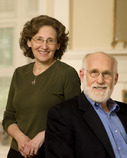
I attended an interesting talk at UCLA by physicians and authors Jerome Groopman and wife Pamela Hartzband. It was called "When Experts Disagree: The Art of Medical Decision Making." It looks like you can watch a video of a similar talk they did at another school online. The talk is related to their book Your Medical Mind.

Pamela studied at Harvard Medical School and did her residency in endocrinology at UCLA. She is now a physician educator and author. Jerome did college and med school at Columbia, residency at Mass Gen, and fellowship at UCLA in hematology and oncology. He's now a staff writer for The New Yorker and author of 5 books. He's done extensive research on HIV and cancer and has about 400 publications. Nice.

My notes and takeaways from the talk are below.

Thesis: When you understand why the experts disagree, you can make better medical decisions.

Conflicting expert opinions in news (looking at same research study results)
Examples:
Take or not take Vitamin D
Mammogram check protocol

Putting a number on utility
Linear scale from 0-1 (0 = death, 1 = perfect health)
Time trade off (how much time to give up to not have side effect)
Standard gamble (estimate odds you'd take to avoid some outcome vs. chance it might kill you immediately)

All 3 methods flawed cognitively
Can't predict future life
People adapt, med conditions not static

Self-reported quality of life not objective

In britain, blindness is rated 0.5 (reduces life 50%)
In US, much higher (blindness not as bad)

Daniel Kahneman gave address recently to med analysts
Classic way of measuring utility like measuring the ether
Textbooks not giving answers

Sir William Osler: listen to the patient, he'll tell you the answer

They interviewed many patients to come up with mindsets.

2 mindsets of people when diagnosed
Maximalist: be proactive, do everything and more
Minimalist: minimize medications

2 mindsets of medication orientation
Naturalism orientation: prefer those extracted from herb (60% of population)
Tech orientation: prefer those synthesized in lab using latest tech

2 mindsets when taking pills
Believers: confident about cure
Doubters: think treatment worse than disease

There's a medical risk calculator online they mentioned
Baseline risk of disease/bad event from your case might be really low (like 1%) vs. message pharma ad says like "med will reduce risk by 30%" (look at absolute risk and risk difference rather than relative)

Cognitive traps
Availability: effect of stories that stay in mind; overestimating likelihood of similar event; when you hear a story, go back to the #s
Framing: 10% of side effect sounds different from 90% of no side effect; physicians just as susceptible

Drug ads: for every $1000 spent, 24 new rx's written
Use stories and #s
#s framed in most positive way (risk reduced 30% [not 30% of 1%])

Dartmouth study found that drug ads make med seem 10X better than really is

Insurance company ads contribute
"Right outcome" is false hope
Controversies around expert opinions

Expert committee disagreements
Mammograms
PSA screening

Their medical mindsets:

Jerome
Eastern European Jewish tradition
Docs on pedestal
Docs heroes like presidents
Sci/tech honored, anything natural was throwback to village life
He is maximalist, believer, and tech orientation: every med and procedure means better health

Pam
1st child in family
Parents were ahead of curve on exercise
She is minimalist doubter

The gray zone
No one right answer for everyone
Patient can ask what would you do; not best way to decide.
Watch and wait vs. surgery yesterday

End of life
Advance directives: 50% of people change minds and choose differently from what wrote (because can't forecast future in circumstances that aren't experienced AND because can't predict all scenarios); experts have formulas for when medicine at end of life is futile, but they don't work in real world because can't identify those who will survive with good life quality
Surrogate decision making: go back to the mindsets

Medical decisions:

Patient mindset: first understand this
Numbers: look to see how apply to the individual
Stories: Daniel Gilbert research on estimating outcome utility best done by talking to someone who had the outcome

When patient knows his/her medical mind, can communicate this to their doc and better explain risk/benefit

Does take time between physician and patient
People aren't automobiles on assembly line; takes time

Studies available online to anyone; doc's role changing from providing info to interpreting info
Patients like understanding where they fit into #s

Patient doesn't have to match mindset w/ doc; doc needs to know how to talk to any mindset

Healthcare reform and economics have insurance companies rating docs and dinging them when patients not complying
50% of medical studies/guidelines overturned in 5 years; 23% in 1 year

Step back and just acknowledge that often don't have good data
instead, government panel just does sweeping regulation that isn't right

Presenting relative risk is allowed but misguides

Merits and costs of drug ads:
Public service announcement vs. hypnotic suggestion/persuasion
Can better restrict how present info

Quality/outcome approaches have failed
Hard to quantity
Those things that matter aren't quantifiable; what's quantifiable doesn't matter
EHR won't save $80B; not as much duplication of tests as claimed
Adds extra costs and time waste from restricted methods of data entry

Problems with metrics-based/pay-for-performance med: creates incentives to meet metrics and not patient care end goal

Checklists good for surgery, procedures, infection decreases but less for medicine

Insurance companies are businesses, not about saving lives or helping you get "right" outcome

Healthcare costs going up because now we have more people living longer.
 
 
I recently attend a UX design event at UCLA, which included a presentation by Joselle Ho, Creative Director and Co-Founder of Miso Media, a music education company that got its start in mobile in 2008. It was a fun event as we got to hear Joselle's thoughts on design, and then a panel of judges critiqued some screenshots of real designs others were working on. Below are some of my notes and takeaways

Joselle

UI != UX

Focus on user's wants, assumptions, emotions.

Design for main use case, bury functionality.

Every excess click reduces engagement 90%.

Replacing "Sign up" with "Learn more" increases sign-ups 350%.

What you say matters.
When you say it matters.

Animations make a big difference (continuity and breaks).


UX critiques

Outside pages need to communicate 2 things: why and how.

Login/Sign up/Help in upper right corner

Call to action must pop out when you squint.

Photo-based navigation preferred over text in studies

Discovery of activity in app: make it a widget, reduce the content amount, make it like a ticker
"ppl who added XYZ also added ABC"notification indicator in menu bar

Tools mentioned:
Blueprint for iPad
Invisionapp
Keynote (has hotspot/click targets)
Axure

Explainer video as sole thing in homepage: not great
 
 
I'm excited about having graduated on Friday from UCLA Anderson. Our commencement speech was entertaining and inspirational, and I wanted to share the top 10 list that Guy Kawasaki shared with us.

Guy shares alma maters with me (Stanford followed by UCLA Anderson), so I identified with him immediately. He was the chief evangelist at Apple and author of ten books (two of which I've read and really enjoyed: Enchantment and The Art of the Start).

You can watch his speech in the video above, and my notes are below.

Guy's Top 10 Practical Tips for Succeeding

1. Aspire to jump to the next curve.
Instead of working on a better sameness

2. Don't worry, be crappy.
When you're on the next curve, it's time to ship.
Ship and then test.

3. Never ask people to do something you wouldn't do.
Whether it's asking customers or employees
Importance of ethics

4. Obey the absolutes.
There's a hard line between right and wrong.

5. Default to yes.
Positive attitude
Always thinking "how can I help others?"

6. Drop everything when your boss asks you to do something.
Make your boss or wife look good.

7. Become a baker not an eater.
For baker's, life's not a zero sum game.

8. Hire people better than you.
A people hire A people. B people hire C people (and so on).
Hire people better than you to prevent a "bozo explosion."
(See my notes on the book Who.)

9. Change your mind.
It's a sign of intelligence.
Steve Jobs changed his mind all the time (and convinced you he was right before and after).

10. 10/20/30 rule of PowerPoint
Optimal slides: 10
Optimal time: 20 minutes
Optimal font size: 30
Figure out oldest person in room and divide age by 2 and that is the font size.

11. Suck it up
Need to pay dues.
Do the dirty job.

12. Have children.
True success is happiness in life.
Children are his greatest joy in life.
Nothing came close in his life in joy.
 
 
Picture
As part of a class I took on biotech, we were assigned to read Science Business by Gary Pisano. I learned a lot from the class and this book, and it really answered a question I've had for a long time: Why does science/medicine move so much more slowly than technology in general?

I learned that the biotech industry as a whole has been barely profitable since its inception, and that there is a severe productivity crisis (productivity as defined by cost per successful drug has been dropping over time, which is very different from something like computer processors which have been dropping in price over time). There is a big "valley of death" between discovery of a compound or process and commercialization. It takes 10 years and $1 billion to get a drug to market, and 1 in 5,000 drugs makes it. WHOA.

People are always optimistic about biotech revolutionizing health, and it hasn't lived up to this potential yet. The book explains many reasons for this and suggests some different approaches and solutions, none of which seems easy or straightforward.

My full notes are below. I'm curious to see how the industry evolves in the future, as many lives could be saved and improved if things change drastically.

I. Preface: The rise of a new industry and a big question
a. Big hopes but disappointing financial returns over time
b. Biotech firms not more productive in R&D than big pharma
c. Fundamental business problems created by science
d. Functional requirements of sector; performance comes from how well it’s managing these (poorly)
i. Risk management
ii. Integration
iii. Learning
e. Monetizing IP leads to bad info flow, fragmentation, proliferation of new firms
f. Biotech can’t just adopt same methods as high-tech
g. Can sci be a biz?
h. Some businesses doing basic sci; some universities treating sci like biz (selling IP, starting co’s)
i. 30 year history of biotech sector data analyzed

II. Ch. 1: the science-based business: a novel experiment
a. Biotech is convergence of 2 separate realms
b. Science biz one that tries to advance sci, not just use it
c. Sci biz needs unique mgmt
d. Sector profits near zero historically
e. Different norms, values, metrics between sci and biz
f. 3 main factors
i. Profound and persistent uncertainty => needs risk rewarding and mgmt
1. Long time horizons for risk to be resolved
2. Appropriability: ability of biz to capture value from an asset
3. Openness vs. secrecy
ii. Complex and heterogenous nature of scientific knowledge => needs integration
1. Cross disciplinary
iii. Rapid progress => cumulative learning

Part 1: The Science of the business

I. Ch. 2: mapping the scientific landscape
a. Locks and keys
b. Random screening
c. rDNA
d. mAb
e. combinatorial chem
f. SNPs
g. Proteomics
h. RNA interference
i. RDD
j. HTS
k. Growing size, complexity, heterogeneity

II. Ch. 3: the complex anatomy of drug R&D
a. Can save or kill you
b. So much still unknown
c. So many places where drug can work wrong
d. Target identification and validation: find enzyme
e. Lead identification and optimization: find molecule to inhibit it
f. Preclinical development: check safety and effectiveness before humans
g. Human clinical trials phases 1-3
h. Reg approval

III. Ch. 4: drug R&D and the organizational challenges
a. Not like processor design; very little knowledge about entire system and overall spec
b. Process very complex and can’t be broken into pieces: uncertainty and integrality
c. Most R&D on losers
d. Active ingredient and formulation both matter
e. New scientific advances increase uncertainty; show more what we don’t know
f. More choice means more uncertainty
g. More advances mean harder integreation

Part 2: The business of the science

I. Ch. 5: the anatomy of a science-based business
a. Many separate technologies
b. Cyclical entry
c. Genentech started industry
i. Close links to universities
ii. Biz model innovation: contract w/ big pharma for funding development of drug and royalties in exchange for manufacturing and marketing rights
1. First time pharma did R&D through external for-profit co
iii. Pursuit of broad range of opportunities/diseases
d. Second generation used more chemistry and focused on research, allowing pharma to commercialize
e. Third gen: human genomics, industrialized R&D, platform strategy
f. Market for know-how
i. More collab w/ biotechs than w/ univ

II. Ch. 6: the performance of the biotech industry: promise vs. reality
a. Long lag times
b. Zero industry profits
c. Huge skews for Amgen and Genentech
d. R&D productivity, revenue-adjusted

III. Ch. 7: monetizing IP
a. Txr of IP from univ -> private new firms
b. Capital markets (VC) and public equity
c. Market for know-how (small firms trade IP for funding from big firms)
d. Go public much earlier for funding
i. Only 20% of public co’s today have ANY product on market, so basically R&D entities ) (GAAP not as useful)
e. Univ research -> startup w/ VC -> IPO for more funding -> license to big co to bring to patient
f. 3 requirements for risk mgmt.
i. Many options for diversification
ii. Adequate info
iii. Abilty to reap reward
g. Market for know-how -> integration
i. But biotech less modular and codified than software
ii. IP protection murky

IV. Ch. 8: organizational strategies and business models
a. Few examples of success, high uncertainty, luck plays big role
b. Financing critical for industry and its main measure, but wrong measure because it’s input, not performance
c. Alliances/IP monetization are important but not endgame
d. Movie studio model for big pharma: produce ideas of independent writers

V. Ch. 9: The path ahead
a. Venture philanthropy
b. Rethinking the publicly held biotech firm (doesn’t match 10 year investment cycle)


I randomly heard that Zao was giving a talk at the UCLA life sciences area about gamification, and I was able to watch it remotely and take some notes. The talk was part of UCLA's "Managing Invention" series, and it was titled, "Hooked on Gaming: Applications for Education, Scientific Knowledge and Marketing."

I met Zao at BetterWorks, and he's one of the smartest guys I know -- quick, action-oriented, and no-BS. He's the founder of MyMiniLife which became FarmVille and the engine behind most of Zynga's social games after it acquired his company.

Notes on the talk are below.

FarmVille story
  • Was working on MyMiniLife on side while doing CS grad degree at UCLA
  • Goal was virtual self-expression through online artwork + interactions w/ others
  • Was turned down by 8 angels
  • Dropped out of grad school
  • Wasn't getting traction for a while
  • Got 2 part-time jobs in Bay Area to bootstrap company
  • Finally got some distribution and traction
  • Raised first round
  • Scaled 1st product to 4M registered users
  • They were the cust serv dept
  • Realized ppl thought of this as a game, wanted simulation + game mechanics
  • Took 5 weeks to re-skin it (FarmVille was just first re-skin); basically pivoting
  • Grew 20-30% per week after
  • Had a bidding war between multiple companies, 4 acquisition + 1 investment offers
Consumer internet trends
  • Consumer internet so fast that core competency is UX, product design, tech execution, not IP protection
  • Consumer internet going more towards bite-sized consumption
  • WWW first started as publishing medium
  • Became bite-sized publishing w/ social feedback
  • Second era from social communities
Virality
  • figured out how to do bite-sized gaming
  • Most play FarmVille at work
  • Virality
  • Broadcast (1 to 1), multicast (1 to many), unicast (one to all)
  • Built in gifting
  • Used newsfeed
  • "Lonely cow" published and others click to help you
  • Different incentives for ppl to interact
  • Virtual goods not gotten unless through others

Psychological tricks

  • appointment gaming
  • psychological bias towards commitment
  • "get in the door" in sales
  • giving you a bunch of virtual currency in the game and telling you to plant seeds and wait
  • you invest it in something and then get reward
  • mechanics map directly to brain reward mechanisms
  • humans have tendency to complete task
  • progression/progress bar
  • hidden/next levels
  • concept of gifting/reciprocity
  • guilt tripping
  • reward mechanisms in brain light up on tweets 
Execution
  • at the time there were lots of farm games
  • just about execution
  • how cute the character, how big the eyes, camera angle, perspective, onboarding user experience
  • hipstamatic had all instagram features but was too complicated and mimicked old features of filter cameras
  • game mechanics
  • social mechanics
  • art style
  • user experience
  • farmville was not the first social app
  • they launched in 2009
  • FB platform launched in 2007
  • a lot centered around experimentation
  • lots of product pivoting in consumer startups
  • certain element of taste and judgment
  • he plays around w/ a lot of apps to understand new/returning user experiences
  • in early days it's extremely manual
  • nuances are lightweight, 1-click feedback mechamism for publishers
Female appeal
  • most social media consumers are women
  • nurturing crops, animals appeal to women
  • males want to challenge and kill each other, competitive
  • females equally competitive in diff. way
  • nice shoes and handbag are decorating yourself by comparing against other females by posing

Gaming
  • gaming companies: playfish, outfit7, zynga, pocketgems, machinezone
  • 4 aspects of gamification: (not just about adding points and leaderboards and badges)
  • 1. figure out what aspirational item of community is
  • in social community, there's always aspirational item
  • youtube: fame
  • facebook: popularity
  • quora: respect
  • 2. seed it with the right community
  • don't get viral off the bat
  • when yelp started, there were 4-5 major competitors, better funded; others did national campaign
  • yelp was UGC site, just wanting SF restaurants to start
  • cultivate community, throw parties and events, reward members
  • do it geography by geography
  • 3. design ego statistics around it
  • for some, badges and points
  • want stats to fit community
  • want 2-3 stats that are the aspirational items for top guys
  • from 100 ppl, 80 will be lurkers, 19 will comment, 1 will post
  • must design around that 1% that posts
  • to create a lot of social feedback, reputational items, lightweight mechanics to provide it to them
  • 4. figure out social feedback loops
  • little feedback mechanisms to publishers: likes, upvote, downvote, comments, endorsing, tagging
  • in social communities, incentive is not economic
  • mostly amateur pro's who want to share expertise
  • incentive cannot be economics
  • encourage and design around intrinsic motivation
Pinterest
  • pinterest pivoted like 6 times because he knows # of investors that said no
  • pinterest was flat for a long time because none of their friends wanted to use it
  • ben silverman went to design conference, a bunch of designers really loved it
  • loved aesthetics and UI
  • from core community then ballooned
BetterWorks
  • reward and recognition software
  • perks
  • in retrospect didn't understand B2B software
  • underestimated sales & marketing side of it, headed by paige craig
  • realized it couldn't scale in early May and laid off half the company in early May
  • # of lessons from it
  • was able to raise money effectively
  • money caused a lack of discipline
  • ironic part of it
  • in 1st company, raised a total of $380K, not a lot when paying salaries
  • were able to raise $2.5M in 1 week and $8M in another week
  • didn't prove out the model before they scaled
  • should've proven out the model earlier
  • should've figured out sales side before scaled
  • MyMiniLife wasn't easy either
  • learned different lessons, brought closer to earth
2 types of pivots
  • soft pivot from hearing customer feedback about which area to go into
  • hard pivot which is completely new idea
  • exploring both options
What he looks for in investments
  • #1 thing that dictates success is "running back" analogy: very persistent and can pivot and roll w/ punches
  • correlates w/ success
  • no one knows the actual stories of the startups
  • very deep domain expertise
  • ability to recruit people
  • steve jobs' reality distortion field: allows you to attract ppl to the cause
  • problem w/ that is you have 2 types who can do it: delusional and actual operators
  • most w/in their domain can execute
  • problem w/ startup is it's emotionally challenging; your social circles won't accept it
  • family was calling him weekly to change; embarrassment of failure; most underestimate pressure from these
  • higher order bit is if want to do startup or not, not whether have great idea
  • all the companies pivoted a lot
  • Sony started as rice cooker co
  • Toyota wasn't car company
Voice recognition
  • valley of disappointment w/ voice recognition techniques
  • certain verticals and communities will take to it but most not
  • still early stages of voice
  • key to voice is the HCI part, not the actual POS recognition
  • Dragon and Nuance have done well there
  • dialog manager
  • how you interact w/ device in smooth manner
  • can you make a game out of voice? not quite there
  • MMO/RPGs
  • probably not for mobile devices
Education applications
  • should be possible but execution hard
  • can produce games teaching math concepts, but less scalable
  • needs to be different format
  • not sure how
  • social community around ppl curating edu content; put reputation points and authority and aspirational levels w/in diff areas (math, etc.)

importance of curation
  • research on experts showed 10K hours/5 years, etc. but this research is old
  • life cycle from academic research, to being well known, to magazine publication, to Malcolm Gladwell book is long time
  • Dumbing down content, thinking of it in diff. way
  • Create a community modeling and speeding this process up

Gathering market data using gamification
  • Carnegie Mellon prof/grad student story: machine vision, image recognition were too hard for machines to process and needed correction from humans
  • Approach was creating a game around posting an image and allowing ppl to recognize objects and interact
  • facilitated image classification and recognition
  • Google acquired the tech
  • Can incentivize social community
  • really depends on the nuances, what community, how seeded


I recently came across a patent article by Fred Wilson and another by Brad Feld, two respected VCs in the tech community. I found their points resonating with me, even though I've been considering the theory of patents from the entrepreneur's perspective. They were saying that suing over bogus software patents (like Yahoo did) didn't make sense, and I buy that. I can also numerous arguments from the entrepreneur's perspective -- one's that I've directly faced and considered -- that make the current system seem pretty ridiculous.

First, the process is overly expensive and quite archaic. The point is to "share knowledge" and publicize inventions so they improve the human condition, but no one sits there reading patents that just got issued, and there's a huge time delay between invention and issue. That time delay causes other problems, including uncertainty and added cost. Also, the people writing and reviewing the applications often don't understand the technology well enough to act right, which causes invalid patents to be issued and fights over validity. And there's the whole problem of patent trolls. The recent reforms requiring first to file cause even more anxiety around the patent decision since you need to decide earlier whether you want to patent or not. This has been the case in Europe forever, where I've heard you pretty much always file provisional patents before you go talk to investors or even create a website. This definitely seems "wasteful" from the "lean" standpoint to me.

While I hate the idea of people stealing ideas, I'm a big fan of competition on quality of product and effort; it's really the execution that matters way more than the idea content.

What creates tension, though, is that there are areas where patents do more good than harm, such as in biotech. I've been taking a biotech entrepreneurship class for my last quarter, and I heard a researcher tell us how no pharma company would consider licensing or buying their technology or helping them commercialize their invention if they didn't have tight-sealed IP protection. While you can get away with software patents from $10-50K, I've learned that UCLA spends $1M defending patents through to issue for life sciences discoveries, so for UCLA, it's an even more difficult question and much bigger investment.

How can these two points be resolved? Do we abolish software patents? Do we have much stricter guidelines on "obviousness" that are spelled out? How do we fix the backlogs in the USPTO and make the process cheaper? Or do we just kill patents altogether and say let the best man/woman/execution win?