Picture
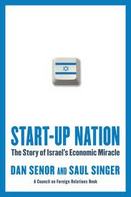
One of the most enjoyable books I've recently completed is Start-Up Nation by Dan Senor and Saul Singer. The book's subject is the entrepreneurial culture in Israel, the country with the greatest concentration of innovation in the world. I found much of the book eye-opening and informative, and I definitely learned a lot about Israel that I didn't know, including many lessons that could translate to improve innovation in the US.

Introduction
  • Example of Israeli innovation: electric cars/BetterPlace. Goal to get one country completely off oil.
  • Israeli population in constant state of dissatisfaction, which causes continuous rethinking of the status quo.
  • Israel has more VCs and startups than any other country.
  • 125% cell phone penetration (people have more than 1 cell phone)
  • Constant struggle against adversity critical part of Jewish culture and fuels entrepreneurs
  • Compulsory military service
  • Culture of informality
  • Culture of questioning authority
  • Completely OK to fail in Israel
Part 1: The Little Nation That Could

Ch. 1: Resistance
  • Chutzpah 
  • PayPal bought fraud tracking system from Israeli start-up.
  • Intel in Israel innovated on microprocessors and created the new parallel/multi-core architecture.
  • Lots of debate in Israeli companies; no bullshit.
  • Constantly challenging authority; healthy conflict.
Ch. 2: Battlefield Entrepreneurs
  • Military constantly improvising in war; improvisation useful skill for entrepreneur.
  • More autonomy and decentralized control in Israeli military than US military
  • Israeli military is anti-hierarchical.
  • Questioning superiors built into the Talmud
Part 2: Seeding a Culture of Innovation

Ch. 3: People of the Book
  • Famous guestbook where travelers leave recommendations for others in hostel
  • Israelis travel a lot.
  • Go far, stay long, see deep
  • Feel confined in Israel after military service
  • Internet software another way to get out (besides travel)
  • "Israel Inside" (like Intel Inside): most innovations we now depend on in all of our gadgets came from Israel.
Ch. 4: Harvard, Princeton, and Yale
  • Hardcore training and recruiting to get into elite military units
  • Reserve unit team is one's second family throughout life.
  • 8200 intelligence unit alumni are elite/most intelligent.
  • "Tabiyot" most selective group
  • Key training: finding cross-disciplinary solutions without guidance
  • Become good at a lot of things instead of one
  • Maturity at a young age
  • Highest % that go to university of any country
  • Military reserves remain a part of everyone's life for decades (annual service requirement)
  • Everyone knows everyone.
  • People take full ownership of missions and business.
  • Little connection to military in US as a civilian
Ch. 5: Where Order Meets Chaos
  • Singapore adopted Israeli military model.
  • But not as innovative as Israel
  • Culture missing initiative, risk taking, agility
  • Apollo mission good example of experimentation and questioning
  • Columbia disaster bad example of strict, routine management
  • Israeli military practices: daily debrief, deconstructing mistakes and experiments
  • Debrief as important as the war
  • Decentralizing authority
Part 3: Beginnings

Ch. 6: An Industrial Policy That Works
  • Key factors that turned around economy: new immigration, new war, new VC industry
Ch. 7: Immigration: The Google Guys' Challenge
  • Brin and Page visited a high school in Israel
  • Many Soviet immigrants; hard science background, drive for excellence in Soviet Jews
  • Israel has intense focus on letting in as many immigrants as possible.
Ch. 8: The Diaspora
  • Many engineers travel back and forth between Israel and SF
Ch. 9: The Buffett Test
  • Google Israel created Google Suggest
  • Industry and business goes on during war; no one stops coming to work.
Ch. 10: Yosma the Match
  • VC funding critical to industry growth; many sources of capital.
  • BIRD financing from government endowment
  • Yosma VC funding through government matching foreign VC investment
  • Allowed performance fees for all asset managers, created finance industry
Part 4: Country with a Motive

Ch. 11: Betrayal and Opportunity
  • France cut off military airplane supplies at key moment of Middle East conflict
  • Had to develop on own; was actually better for Israel in long run to be self-sufficient and fueled their deep innovation in aerospace and nuclear power.
Ch. 12: From Nosedowns to Geysers
  • No bad lending practices or sub-prime crisis in Israel
  • Innovation continues
Conclusion: Farmers of High-Tech
  • Perez was a founder of industries, serial entrepreneur, 2 time prime minister.
  • View of agriculture: 95% science
  • Ben Gurion thought the future lay in science as well.
  • Nuclear power
  • Jewish culture of dissatisfaction
  • Great universities, start-up ecosystem, military culture
  • Aggressiveness and team orientation
  • Failure not a stigma
  • Idea factory


Comments


Your comment will be posted after it is approved.


Leave a Reply