Picture
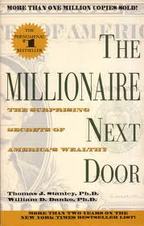
At the recommendation of several people, I read The Millionaire Next Door, a book debunking a lot of myths around who millionaires are and how they live their lives.

I found the book interesting, and a lot of the data the authors gathered definitely surprised me (they surveyed over 11,000 millionaires). I thought, however, the the book was too focused on data and statistics; listening to the audio version made it painfully clear how many numbers and statistics were in the text.

I also was disappointed that the authors didn't spend much (if any) time in their text going into the question of the purpose of wealth accumulation. A lot of focus was on how people accumulate wealth and how not to get carried away consuming, but there was little or no discussion of the happiness that results from consumption and how short-term happiness can or should be traded off against long-term financial security and wealth accumulation. I understand this is something very personal that everyone decides, but it would've been nice for the authors to talk about how such a decision can be made.

Finally, it would be nice if the book were updated for any changes that might have happened in recent years in buying habits, incomes, etc.

Below are some of my main takeaways/notes on the book.

  • Wealth is not the same as income.
  • What's important is how much you accumulate, not how much you spend; many people who earn less but are more careful with spending become much wealthier than those with high salaries and high-consumption lifestyles.
  • Building wealth takes hard work, planning, and self-discipline.
  • The most affluent-looking neighborhood actually often doesn't contain the wealthiest households, just the ones with the most conspicuous spending.
  • Most millionaires are the first generation in their family to become wealthy.
The 7 Common Factors of a Millionaire
  • Lives below means
  • Allocates money and time efficiently
  • Considers financial independence more important than status
  • No parental help
  • Children self-sufficient too
  • Proficient in targeting market opportunities
  • Chose right occupation

Research Findings
  • Little spending on clothes
  • Most millionaires don't drive foreign luxury cars and rarely lease.
  • Looks are often deceiving. Texas saying: "Big hat, no cattle" (people who spend more on clothes but actually have little business progress)
  • Own home, American car
  • Save 60% of income
  • 2/3 are self-employed
  • Spend heavily on children's education
  • Married to same person whole life
  • Invest 20% of income
  • 95% have between $1-10 million
  • Wealth defined by net worth
  • What your net worth should be: your age times your pretax income divide by 10
  • Wealth affected by consumption habits; calculate the years you can live at your lifestyle without working
  • 19% receive some wealth from parents
  • Country of origin unimportant
  • Immigrants: self-employed, most important factor to building wealth
  • Russian ancestry group highest accumulators of wealth. Russians have 5% of all wealth in US -- due to an entrepreneurial spirit that goes from generation to generation.
  • Scottish also account for large portion of millionaires compared to population %. Scottish are very thrifty, compensating for lower income. Scottish offspring are financially independent.
  • Entrepreneurs teach their children to do the same and have a better life through education.
Foundation for Building Wealth
  • Frugality
  • No expensive products 
  • Never spend more than $399 for most expensive suit (example)
  • No need to impress anyone
  • Can't show employees that you're making too much money
  • Never spend over $140 for shoes (example)
  • Press sensationalizes those who spend crazy amounts (like celebrities), but these people very often go broke.
  • Half of the millionaires surveyed never spent over $300 for a watch.
  • Most people pile on debt to spend now.
  • Jobs that lead to wealth creation are often not sexy.
  • Parents of millionaires were frugal and taught frugality to their children. Spouse is often even more frugal than the main earner.
  • Intense focus on budgeting and planning all expenses
  • Invest 15% of income before spending
  • 8 hours per month spent planning investments (but not active trading); buy and hold -- more time on fewer deals to study
  • Plan and manage investments in areas of expertise
  • Teach kids the importance of investing
  • Tabulate all home expenditures per month and budget for future
  • Defined quantitative goals per day, week, and year
  • Derive happiness from security and family.
  • No display of conspicuous artifacts
  • Minimize income taxes by minimizing realized income
  • People who optimize this the most pay 2% of wealth in taxes per year.
  • If you're not yet wealthy, don't purchase a home requiring mortgage payments of twice your annual realized income.
  • Allocate time, energy, and money efficiently
  • A lot of time spent planning investments and meeting with quality advisors
  • Begin investing early in life
Selecting Advisors
  • Background checks
  • References
  • Ask for college transcript
  • Ask for evidence of past work
  • Use personal referrals
Wealth better than displaying social status
  • Cars: average maximum paid was $20K; never current year model; 1/3 had used car; very few lease; prefer American models 
  • Most shopping at Sears
  • Never buy retail-priced suit
Economic Outpatient Care
  • This refers to gifts to adult children, which happens a very large % of the time.
  • Becomes a dependency
  • Teaching frugality and independence better than giving cash gifts
  • Recipients of gifts under-accumulate wealth.
  • Weakest sibling get most of inheritance (need-based) but goes less far.
  • Select outsiders among executors of estate. Distribute money once children mature to a certain age and career standing.
Raising Kids
  • Never tell kids their parents are wealthy.
  • Teach discipline and frugality. Teach by example.
  • Assure kids won't know you're affluent until they are mature.
  • Distribute inheritance once kids mature, 40 years old, and have career.
  • Never give cash gifts.
  • Minimize discussions of inheritance and gifts.
  • No gifts from negotiation.
  • Stay out of kids' family matters. Ask permission to give advice and gifts.
  • Never boast of your past achievements or what you had at the kids' age.
  • Always remember that children are individuals and will be unequal.
  • Emphasize kids' achievements, no matter how small or different.
Pick a Niche, Supply the Affluent
  • Estate, tax, and immigration attorneys
  • Psychologists
  • Chiropractors
  • People providing stress relief
  • Appraisers, auctioneers
  • Real estate management professionals
  • Education professionals
  • Private school
  • Travel
  • The character of the business owner is more important than the type of business.
  • Non-sexy businesses are most stable and less competitive and produce greater wealth.


Comments

Scott Simmons
04/03/2011 14:53

Max, what does "pick a niche, supply the applicant" mean? Are they saying that picking a niche is a means of becoming affluent, and these are good niches to choose?

Reply
Max
04/03/2011 14:57

Hey, Scott! Great to hear from you.

"Pick a niche, supply the affluent" is actually both of the things you mentioned. The primary suggestion there is to pick a niche that involves supplying the affluent: being an advisor to them, providing some service or product (like the niches/professions listed that all are in high demand by the affluent). As the affluent community grows, there will be more demand for professions and services catering to them. By working in that field, one can make money as well and also become affluent (that's a secondary interpretation).

Reply
g
04/03/2011 16:42

whoa, i'm way behind on net worth

Reply

Your comment will be posted after it is approved.


Leave a Reply