
Max Mednik
  • Home
  • About
  • Interests
    • Angel investing
    • Magic
    • Scuba Diving
  • Blog
  • Contact

Readings and musings

Lessons Learned from Week 3 of Fall Quarter

10/15/2011

0 Comments

 
Picture
Ethics
  • Compliance (follow law) vs. Integrity (values-driven, culture that supports ethics)
  • Role of religion/spirituality/personal values in business. When should they be separate, and when must they align?
  • A company's role in individual freedom vs. protection of employees. If a company must restrict certain jobs to specific demographics due to safety reasons, is that discrimination?
  • Publishing as yourself vs. representing your company. This is particularly relevant today, where people have multiple social identities online (and companies have their own online identities as well). I think the most important thing is that people be very clear on whose thinking they are promoting and what interests and affiliations they have.
  • Good book: Memos from the Chairman
  • What should be the role of auditors and accountants in ethics?
Behavioral Finance

  • Technical analysis works (memory in stock prices).
  • Irrationality -> mispricing -> corrected later
  • Divergence
  • Head and shoulders (powerful in forex)
  • Moving averages work (in long-run 26 weeks, short-run 4 weeks; hold 2 weeks - 1 month).
  • Momentum strategies work.
  • Support level due to "left digit bias/effect" (e.g., $9.99 pricing)
  • Mutual fund cash positions are a contrarian indicator.
  • Monthly put/call ratio is a contrarian indicator.
  • Momentum strategies highly profitable
  • If stock we buy goes up, we buy more; if it goes down, we don't sell and attribute it to bad luck due to cognitive dissonance
  • Prices drift up over time after stock added to buy list or has earnings surprise (not immediately priced in).
Doing Deals
  • This class was a real treat, as we got to hear from Jason Nazar, CEO of Docstoc, and Dave Travers of Rustic Canyon (Docstoc's VC)
  • If you don't know your big "why," the what and the how will always distract you.
  • Jump into situations you don't know, prove out demand, figure out supply afterwards
  • Meet 4-6 entrepreneurs and investors per week, maintain relationships and build new ones
  • VC negotiations are a test of the entrepreneur as a negotiator
  • In deals, people are more important than the terms.
  • Right way to think of "price"/"valuation" in a VC deal: payoff curve of payment (to a specific party) versus exit price
  • Best situation for co-founders: different skills and different ownership stakes
  • Negotiation tip: first create value if you want good terms.
  • Negotiation tip: seek to understand before you seek to be understood.
  • Negotiation tip: Start with the big points, then do the little things after.
0 Comments

Notes on Steve Blank and the Second Decade of Customer Development

10/13/2011

6 Comments

 
Picture
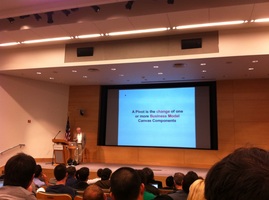
I had the pleasure of seeing Steve Blank at a LeanLA event at UCLA Anderson last week. It was epic. Everyone in the SoCal tech community came out, and I learned a lot of useful stuff from the creator of the customer development movement himself.

Below are my notes on the talk.

Background
  • Steve did 8 startups in 21 years
  • Retired because wanted to see his kids grow up
  • See his post: Epitaph for an Entrepreneur
Introduction
  • Realized so many processes for product pev but no processes for customer dev so wrote a book about it based on what he learned

What's a startup?
  • 6 types of startups
Lifestyle startup
  • Known customer with known product
  • Pay for their hobby
  • Surfing instructor
Small biz startup
  • Work to feed family
  • Grocery store, plumber
  • Exit criteria: profitable biz, existing team
  • 99.7% of all companies employ 50% of total US workers
  • 5.7 million small businesses with < 500 people
Scalable startups
  • Unknown customers
  • Unknown features
  • TAM > $500M
  • Attract VC because VCs want obscene returns (like the mob)
Search, build, execute
  • Startups search for a scalable biz model
  • Founders are not going to be CEO of big company because they will get fired
  • Large companies execute on biz model
  • In middle, founders depart and professional mgmt comes in
  • When you find a repeatable biz model, VC will then figure out if you will be the executing operating exec or someone else
Buyable startup
  • Goal is to solve problem for internet, mobile, gaming apps
  • Sell $5-50m acquisition
  • Super-angels fund these
His startup definition: a startup is a temporary organization used to search for a repeatable and scalable business model.

Business model found
  • Product-market fit
  • Repeatable sales model
  • Managers hired
Big companies good at sustaining innovation
  • Existing market, known customer
  • Known product features
  • In a large company, a disruptive innovation creates a new division
  • Or external competitor does disruptive innovation
  • Counter disruption by building, partnering, or acquiring IP, talent, product, customers, business
Social entrepreneurship startups
  • Don't want to make money
  • Solve pressing social problems
  • Social enterprise: profitable
  • Social innovation, new strategies
Each of 6 startup types requires different skills
  • Startups are not smaller versions of large companies
  • Large companies execute
  • Startups search
  • Accountants don't run startups
  • Startups require metrics, not accounting
  • Save accounting until you have something to account
  • Startup metrics are only ones that matter for board meetings
  • Customer acquisition cost
  • Viral coefficient
  • Customer lifetime value
  • Average selling price / order size
  • Monthly burn rate
Customer validation versus sales
  • Large company sales are scalable, have price list, revenue plan, data sheets; VPs of sales play golf, have gray hair, have a sales organization that sells in a scalable way
  • Startups look for customer validation
  • Large company execs comfortable with certainty and can't adjust quickly
  • Startups: pricing, features unstable, one-offs, sales done by founders
  • Sales titles the same but the job specs are completely different
  • Startups: agile development, not QA and Tech Pubs
  • Maximize releases per day
  • Continuous learning
  • Minimum feature set
  • Large companies plan, business plans describe knowns, features for line extensions
  • Startups model and test
  • Focus on business model generation
  • No business plan survives contact with customers
Business model: 9 building blocks
  1. Customer segments
  2. Value propositions/product or service
  3. Channels: how deliver
  4. Customer relationships: how will create demand
  5. Revenue streams: what will pay for
  6. Key resources: world class engineers, team
  7. Key activities
  8. Key partners, suppliers
  9. Cost structure

Business model canvas
  • Start with multiple business models and sketches
  • These are just hypotheses

Customer development
  • The founders get out of the building and search for the business model
  • Customer discovery
  • Customer validation (pivot back)
  • Customer creation
  • Company building
Use MVP in first 2 steps
  • Smallest feature set that gets you the most orders/learning/feedback/failure
  • Pivot = change in 1 or more business model components
  • Iteration without crisis
  • Fast, agile, and opportunistic
  • Pivot cycle time matters
  • Minimum feature set with instant customer feedback

Second decade: web, mobile, cloud
  • Distribution channel: physical or virtual
  • Products: physical or virtual
  • Customers often teach you explicitly how to price the product
  • First test customer segment and value prop
Student examples from Stanford Lean Launchpad class
  • Lots of pivots
  • Students blogged progress
  • Photos of interviews
  • Videos posted
  • Surveys posted
  • AB testing results posted
  • Use Lean Launchlab

His slides on slideshare

Miscellaneous

  • Slides on SlideShare
  • Talk to press when your positioning has been stable for several weeks
  • Dysfunctional families the best creators of founding CEOs because used to constant chaos and change
  • Bring order out of chaos in life


Recommended books
  • The Innovator's Dilemma
  • The Innovator's Solution
  • The Lean Startup
  • Business Model Generation
  • The Four Steps to the Epiphany
6 Comments

Notes on Neuromancer by William Gibson

10/11/2011

0 Comments

 
Picture
I finally made it through William Gibson's Neuromancer, which was on my reading list for a while. (I'm trying to mix it up a bit with some fiction.)

A ton has been written about this book, which many say was one of the most seminal works of science fiction of all time. I'll just concentrate on my own takeaways and the things I found most interesting in the book.

First of all, my biggest reaction came as a fan of The Matrix. Did the creators of the movies take 90% of their inspiration from this book, or is it just me? The locations, the scenes, the "jacking in to the matrix," even some of the characters (Molly/Trinity, Case/Neo) -- they're almost copies. I guess this might be an example of the saying, "imitation is the highest form of flattery" (or that "good artists borrow, great artists steal"). I love The Matrix, but I am now more down on it since I see it as less original.

Overall, I found the book extremely well-written and quite different in its language than other science fiction I have read. The biggest thing in the book that made me think was the issue of technology to change our physical bodies and minds -- upgrades and implants. Things like heads-up displays (augmented reality), improved physique, geolocation -- wait a minute, is this sci-fi or real life? It's exciting and scary that these things are converging. Should there be a line we draw? When are we no longer human? Or is humanity just defined by our brain/mind, so if we change everything else we're still human? What if we change/improve/fix our brain with a machine? What if a machine runs our brain?

The epilogue of the book was actually one of the most interesting chapters for me to read as it was written by another sci-fi author analyzing Gibson's work. The analysis focused on how Neuromancer was a projection of Gibson's past and present onto his vision of the future. How much of our hope (or fear) about the future is defined by our past and current reality?

Fun book -- definitely recommended to any Matrix fans out there.
0 Comments
<<Previous
Forward>>

    Archives

    July 2024
    June 2024
    May 2024
    March 2024
    February 2024
    January 2024
    November 2023
    August 2023
    June 2023
    May 2023
    April 2023
    February 2023
    January 2023
    December 2022
    November 2022
    October 2022
    September 2022
    August 2022
    January 2022
    October 2021
    August 2021
    July 2021
    June 2021
    May 2021
    March 2021
    February 2021
    January 2021
    December 2020
    November 2020
    October 2020
    September 2020
    August 2020
    July 2020
    April 2020
    January 2020
    December 2019
    November 2019
    October 2019
    September 2019
    August 2019
    July 2019
    May 2019
    March 2019
    January 2019
    December 2018
    November 2018
    October 2018
    September 2018
    August 2018
    July 2018
    June 2018
    May 2018
    April 2018
    February 2018
    January 2018
    November 2017
    October 2017
    September 2017
    May 2017
    April 2017
    November 2016
    October 2016
    September 2016
    August 2016
    July 2016
    June 2016
    May 2016
    December 2015
    November 2015
    October 2015
    September 2015
    August 2015
    July 2015
    June 2015
    May 2015
    April 2015
    March 2015
    February 2015
    January 2015
    December 2014
    November 2014
    October 2014
    September 2014
    August 2014
    July 2014
    June 2014
    May 2014
    April 2014
    March 2014
    February 2014
    January 2014
    December 2013
    November 2013
    October 2013
    September 2013
    August 2013
    July 2013
    June 2013
    May 2013
    April 2013
    March 2013
    February 2013
    January 2013
    December 2012
    November 2012
    October 2012
    September 2012
    August 2012
    July 2012
    June 2012
    May 2012
    April 2012
    March 2012
    February 2012
    January 2012
    December 2011
    November 2011
    October 2011
    September 2011
    August 2011
    July 2011
    June 2011
    May 2011
    April 2011
    March 2011
    February 2011
    January 2011
    December 2010
    November 2010
    October 2010
    September 2010
    August 2010
    July 2010
    June 2010
    May 2010
    April 2010
    March 2010
    February 2010

    Categories

    All
    Angel Investing
    Cacti
    Cars
    China
    Community Service
    Culture
    Design
    Djing
    Dogs
    Education
    Entertainment
    Entrepreneurship
    Family
    Finance
    Food
    Google
    Happiness
    Incentives
    Investment Banking
    Judaism
    Law
    Lighting
    Magic
    Marketing
    Medicine
    Networking
    Nolabound
    Philosophy
    Professionalism
    Psychology
    Reading
    Real Estate
    Religion
    Romance
    Sales
    Science
    Shangri-La
    Social Entrepreneurship
    Social Media
    Sports
    Teams
    Technology
    Travel
    Turtles
    Ucla
    Venture Capital
    Web Services
    Weddings
    Zen

    Subscribe

    RSS Feed

Picture
Picture
  • Home
  • About
  • Interests
    • Angel investing
    • Magic
    • Scuba Diving
  • Blog
  • Contact