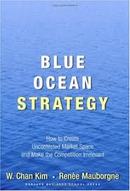
I recently read Blue Ocean Strategy by Kim and Mauborgne. Its focus was on ways to create and release products that are so different from the competition's that the "ocean" is blue, not bloody red. It was a quick, useful read, and what I enjoyed most were the company examples the book analyzed. I found the sections that actually prescribed theory and mechanisms for creating blue ocean innovations the most lacking in specificity, but the overall frameworks made sense to me.

Below are my main notes and takeaways.

Part 1: Blue Ocean Strategy

Ch. 1: Creating Blue Oceans
  • Cirque du Soleil versus Ringling Bros.
  • Red ocean: bloody competition
  • Blue ocean: expands industry boundaries and competition irrelevant
  • Inventions spur blue oceans
  • No perpetually well-performing companies
  • Looking at industries and strategic moves is more informative than specific companies
  • Value innovation: create so much value that competition irrelevant
Ch. 2: Analytical Tools and Frameworks
  • Strategy canvas
  • Value curve/strategic profile
  • Don't look at current competition; look at alternatives and non-customers
  • 4 actions framework
  • Eliminate, reduce, raise, create (grid)
  • Example: Yellowtail wine
  • Example: Southwest
  • Extreme focus on value innovation and letting all else go
  • Have much different value curve than competitors; make tag line that's very memorable and different from others because product so different
  • Focus, divergence, compelling tagline
Part 2: Formulating Blue Ocean Strategy

Ch. 3: Restructuring Market Boundaries
  • 6 paths framework
  • Challenge 6 fundamental assumption
  • Look across alternatives, not just substitutes in an industry
  • Example: NetJets
  • Look across buyer groups and customer chain for unaddressed segments
  • Look across complementary products and services, whole customer experience
  • Look across functional or emotional appeals and include both
  • Examples: Swatch, Body Shop, Cemex, Vanguard, Pfizer/Viagra, Starbucks
  • Look across time, trends
Ch. 4: Focus on the Big Picture, not the Numbers
Ch. 5: Reach Beyond Existing Demand
  • Think about commonalities in non-customers rather than finer segmentation of existing customers
  • 3 tiers of non-customers 
  • Non-Customers who slightly use your service
  • Refusing non-customers
  • Unexplored non-customers
Ch. 6: Get the Strategic Sequence Right
Part 3: Executing Blue Ocean Strategy

Ch. 7: Overcoming Key Organizational Hurdles
  • Tipping point leadership
  • Don't convince through numbers or reports
  • Have people experience problems firsthand
  • Focus on key influencers in organization
  • Focus on acts of disproportionate influence
Ch. 8: Build Execution into Management
  • Get buy-in
  • 3 E principles
  • Engagement
  • Explanation
  • Clarity of Expectations
Conclusion: Sustainability and New Blue Oceans
  • Watch competitors' value curves over time and innovate when they converge with yours


Comments

Bhagya
10/30/2011 14:53

I have started reading Blue Ocean last week and your notes are quite good and informative. Do you have any analytical tools to apply BOS and if so could you fo please share it? I am doing project for my MBA and looking for some company where I can apply this strategy for any problem company is facing .

Thanks in advance.

Reply
Max
10/30/2011 15:55

My best advice would be to check out http://www.blueoceanstrategy.com/. They have a bunch of resources online. I haven't found other tools out there yet, but there may be others as well.

For an MBA project, you could focus on a new product that a company is trying to release or pick a company and suggest a new product they could release and how they could do it in a "blue ocean" way that changes the way the competition is analyzed and thought of.

Reply

Your comment will be posted after it is approved.


Leave a Reply