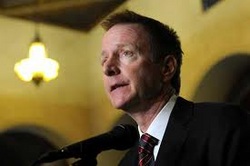
 Austin Beutner, a well-known politician and arts philanthropist, spoke to our leadership and ethics class a couple weeks ago. The talk gave me an interesting perspective on how it's possible to turn around city government organizations and be entrepreneurial in the context of public service.
Beutner started his talk with his background and family information. His dad was a mechanical engineer, and Austin was taught from a young age to be serious about college and work while he was growing up. He remembers constantly washing dishes, cleaning printing presses, and driving delivery trucks for a florist. He went to college at Dartmouth and moved to Wall Street in 1982. He was part of the Blackstone Group before beginning his work in government with the State department. He remembers visiting the mayor of St. Petersburg and learning that in the Soviet system, "profiting" literally meant taking advantage of someone. This was in large contrast to his own understanding of the concept, and he realized how likely miscommunication can be with different languages and social idioms at play. This also taught him the importance of always trying to listen. After this experience, he started own firm that operated in various areas of finance. He did this until he got into a bad biking accident and decide to change careers. That's what got him to stay in the LA City public office. He felt passionate about changing the culture of how people worked in City Hall. He felt that all City employees should be public servants; the city's citizens should be their customers. (Instead, it's usually about enforcing and writing rules.) He had three major initiatives while in office. First, he wanted to "do more with less bureaucracy." One example of this was "12 to 2": reducing the number of City departments one had to interact with to get a permit from 12 to 2. His second initiative was learning from others (both for himself and for all his employees). All his employees had to do 5 cold calls per week to customers of the city (private sector employers). He personally talked to auto dealers, who are the #1 payer of sales tax and among the top 5 in aggregate payroll. They told him that they were having trouble finding entry level talent, and so he brought them together with community college leaders and started a dialogue about matching the two together. His third initiative was reducing bureaucracy. He had the idea for a business tax holiday: a temporary pause on business tax to bring businesses back to LA. He called up some business school heads and professors to write papers and went on to announce the business tax holiday with Schwarzenegger thereafter. In addition, he worked to create local preferences for using LA vendors for the City. The talk was interesting, and it was exciting to hear him tell us that he'll be running for mayor of LA.
2 Comments
carloblacksun
6/1/2011 11:01:15 am
A great speaker indeed.
carloblacksun
6/1/2011 11:02:03 am
So my punchline is "it's a lot easier to cut bureaucracy on paper than in practice"... Your comment will be posted after it is approved.
Leave a Reply. |
Archives
February 2023
Categories
All
Subscribe |
 RSS Feed