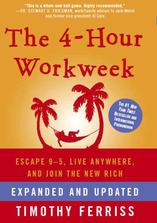
The overall concept has to do with lifestyle design: structuring and optimizing every part of your life so that you can make concrete progress towards living your dreams here and now, rather than in the distant future. The author has made himself an expert in many fields, such as entrepreneurship, travel, Japanese, tango, health, martial arts, online marketing, and product design. As a person with many interests and hobbies myself, I have respect for a fellow Renaissance Man.
My own philosophy has a lot in common with Tim's, which is why I found his book really striking a chord within me. However, it also made me realize how much of my own behavior and habits is self-destructive and pointless, even though I've been proud of those same habits for many years (e.g., "time management" and "promptness with email"). At times, those skills are helpful, but TIm does a great job explaining the danger behind them.
This book had so many details and concrete suggestions that there is no way I can do them justice in a blog post that I want to keep relatively short. I will just try to highlight the most relevant or interesting suggestions. A lot of info can be found at 4hourblog.com.
The overall book can be summarized by a simple acronym: DEAL.
- D: Definition. Define what you want in life, your goals, your dreams -- the concrete activities you want to do or skills you want to master. You don't need a reason for them; they can be selfish or they can be serving the world.
Don't waste the most productive years of your life and wait for retirement to fulfill your dreams. Distribute mini-retirements throughout your life, such as taking 1 month to learn/travel for every 2 months of work. Forget the people who tell you that doing personal stuff is lazy.
Relative income is more important than absolute income. You can earn money in dollars and spend money in a foreign currency (living abroad) and can create a very comfortable lifestyle.
Conquer fear by defining fear. Spend time living coarsely to know that which you fear (being broke or on the streets) and not be afraid of it. What you most fear is usually not that bad. Success is defined by the number of things you do each day that you're afraid of or are uncomfortable doing; it is really those actions (such as that difficult phone call you've been putting off) that move your objectives to completion. Do one very scary thing every day.
In fact, there is often less competition for bigger goals. It is easier to achieve unrealistic goals sometimes because few try.
Dreamlining: apply timelines to dreams. Turn your big goals into defined steps that you can take concrete actions towards. You'll be surprised how little money it takes to live the life of your dreams or have the mini-retirement you want to try out. - E: Elimination. Remove activities, tasks, technology, people, and physical items that waste your time and energy. One of these is checking email. Another is simply the philosophy that you must stay on top of everything; learn to let things slip which are not costly to fix in order to be able to devote yourself to the things that matter to you. This really went counter to how I used to operate, and I'm now running everything I do through this new filter/philosophy.
The big rule in this topic is 80/20; most of the valuable work is done in 20% of the time. What you do is more important than how you do it; effectiveness is more important than efficiency. I feel as if I've always been a slave to efficiency and spend so much time and money learning about ways to be better at squeezing in more tasks into my schedule; the author's approach is completely different. Eliminate everything unnecessary, and free up time to actually live life.
Being busy is a form of laziness. Doing less is the path of the productive. Don't get sucked into the habit I always find myself in: "w4" (work for work's sake). Lack of time indicates a lack of priorities.
Parkinson's Law: Tasks will swell when you have more time. Shorter deadlines create greater focus. Limit tasks to the important, and shorten tasks to ensure fast completion. Remove poisonous friends who drag you down or waste your time.
Complete only 2 mission critical items per day; set up this 2 task to-do list the night before. Do not multitask. Ask yourself 3 times per day if you're just inventing work.
Stop asking for opinions, and propose solutions. Make decisions personally and professionally.
Live on a low information diet. Information depletes attention and creates w4w. No news, no email or voicemail checking when traveling. Reading more than using your brain is bad; you should be outputting more than you're inputting. Just let others synthesize information for you (such as by asking others, "Anything interesting happen today in the world? I didn't get my morning paper."). Focus on just-in-time information over just-in-case information. A bit of fiction reading is ok though.
Master the art of unfinishing. This one is a really sticking point for me. Just because you started something doesn't mean you need to finish it.
Refuse and avoid meetings. If you have to meet, get clear agendas up front. Prefer email then phone then in-person. Use Grand Central/Google Voice and other services listed in the book to make your life easier. Answer voicemail with email. Use if/then structure of messages to cover all the scenarios to avoid back and forth and take yourself out of the loop.
Batching is the solution to routine tasks. Batch personal and business tasks as much as possible until the repair costs (of doing this too late/past deadlines) exceed your hourly time cost. Grant as much power as possible to subordinates to work without you. Life is not scaleable if you're the decision and information bottleneck. Give authority for fixed amounts of spending and review the impact of others' decisions periodically; try this for short trial periods.
Other time savers: Evernote, Scansnap, Doodle (I recently started using Tungle.me), Xobni, Copytalk, and Earth Class Mail. - A: Automation. Find a business and automate it. This book made me realize that there is probably more to life that can be automated and outsourced than cannot. There are many ways to take yourself out of the picture so you are no longer the bottleneck and the world around you (such as via virtual assistants) can work while you sleep.
Eliminate and automate before you delegate to others. Define rules and processes. Each task must be time consuming and well defined for virtual assistants (VAs). Have fun with it (like having them send emails to friends on your behalf). Create separate logins for them to use for your main accounts, email answering, etc.
Find your muse: Own a business and spend no time on it. Outsource all infrastructure. Cash flow and time allow for anything. Minimize initial investment, and test before you produce through a landing page. Pick a niche market, and develop a product for a known market opportunity.
Several ways of doing this: Resell a product; license a product; create a product; or create, repurpose, or license content. No need to be an expert. You can create how to/information products like 2 CDs, a transcription, and quick start guide. Take a skill you know and apply it to a specific market which doesn't have it. Microtest your products with simple AdWords campaigns. - L: Liberation. Negotiate a remote-working agreement for your job. Start your own online business that has everything outsourced and just takes a couple of hours to run.
Management by Absence (MBA): Remove the human element, and
plan your business with the end in mind of being out of the picture. The book gives lots of great advice and scripts for negotiating remote work agreements with your boss.
Mini-retirements: Traveling often saves money over living expenses in the US. Arrange to teach language classes abroad. Tons of resources are listed in the book for figuring out and "hacking" travel in a sense.
If you do this, you will need to face the reality of figuring out what it is you want in life and filling the time void. People dread doing this and avoid this by filling up their time with work or excuses for why they can't live life now. One way to get over this is to just pick big goals and peak life experience to pursue, like mastering Japanese in Tokyo or winning a tango dancing contest in Buenos Aires. A goal could be some form of continual learning and service. You could focus on language acquisition and some physical skill or sports. You could work to Improve the world in any way you want.
Don't worry about questions without answers or philosophical questions over which you have no control. Slow down; attend silence retreats. Write down doubts in a journal. Recapture childhood dreams, and try them out as part-time vocations/callings. (This is something I've always thought about doing!)
In order to do big things, let many small things slide. Limit your options. Don't scan your inbox over the weekend. Fast decisions preserve usable attention. Limit the options you consider and the time you allow for consideration. Try to not complain for 21 days. Don't deliberate past decisions. Create a "Not to do" list.
Don't please all your customers -- only the best ones. Limit yourself to what you know and what you do great; enhance your strengths instead of worrying about your weaknesses.
Let small things go; pay late fees. Don't carry a cell phone 24/7. Live one day per week without technology.
The parts of the book that I question the most or do not fully agree with have to do with the cautions about technology and reading. I think it is clearly the case that there is too much information out there, and it is easy to get sucked into it. However, I think that if a person finds enjoyment or fulfillment from reading books or listening to audiobooks (also prohibited by the author, except for his audiobooks), then that's ok. In addition, I think it's fine to pursue businesses where you want to be actively involved and enjoy that. In general, the author's viewpoint is a little extreme (obviously to make a statement) but more or less correct.
I definitely recommend this book to any other perfectionists, work-a-holics, and Renaissance Men and Women out there.

RSS Feed