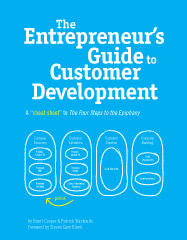
 I recently finished reading a book co-authored by my new friend Patrick Vlaskovits. It's called The Entrepreneur's Guide to Customer Development, and it was a fast, enjoyable read. The book's subheading is "A 'cheat sheet' to The Four Steps to the Epiphany," a different book by Steve Blank. As Patrick described to me recently, Steve's book is the bible on customer development practices but is thick and filled with tons of information that is handy as a reference but takes dedication to read from start to finish. Patrick's aim with his book was to distill the main concepts into an easily digestible introduction. I enjoyed reading Patrick's book, and it did fulfill its goal. I'm now motivated more than ever to try to read Steve's book soon. I also was fortunate to recently attend a LeanLA meet-up where I got to meet other members of the community interested in lean start-up concepts (and hear from the founders of Sharethrough how they used lean concepts to build their business). The "Lean" movement, as I've recently learned, is basically combining customer development practices pioneered by Steve Blank with agile development concepts that have been gaining traction in the tech community over the last 5-10 years. The core lessons I took away from the book were as follows. The book is short and sweet, so I won't spoil all the fun (no need to write a distillation of a distillation); go grab a copy yourself. It also has awesome case studies and templates of emails and cold calling example scripts that you probably won't use verbatim but illustrate the concepts really succinctly. - Question your assumptions. The book calls it "Naive Thinking," and it's eerily similar to the Zen philosophy of "beginner's mind." I also liked how the book's authors tied in Taleb's similar viewpoints in The Black Swan. Make guesses about reality, but don't consider yourself ever right or having full understanding; always seek to disprove yourself and find evidence of how your thinking is not correct so you can learn and actually create products the world needs. As the book says, "The second most desired outcome is the realization that there is no market," and "separate the zeal of entrepreneurship from the blindness of hubris."
- Get out of the building. This relates closely to the first point. Speak in person with as many real customers as possible to understand if your assumptions and product are actually adding value. This is "designed to minimize your real and opportunity costs."
- Build a minimum viable product and validate it with your customers. This means not wasting time getting it perfect and working more towards getting eyeballs on it and constructive feedback rather than building something amazingly cool tech-wise. Your most likely initial customers will be early evangelists and tech enthusiasts; you will have to work hard and may need to adapt the model and product significantly to appeal to a wider audience, but you need to gain a good foothold among the early adopters who will be willing and interested in trying your product and giving feedback.
- Pivot to adapt your product as you learn new information. Through agile development concepts and continuous, quick feedback loops, you can take in new information you receive from customers and adapt what you have to suit the market better. In pivoting, you keep something constant (your foot that stays on the ground) and change some other aspect slightly based on what you learned (your foot that moves). In that way, you don't totally lose your balance or risk completely going down the wrong path.
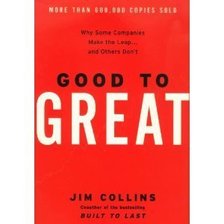
 I recently enjoyed reading Good to Great by Jim Collins. It was as close to a scientific analysis as possible of stock returns of companies versus their mediocre peers and what common threads made those returns possible. Below is a synposis of the main lessons I learned from the book. Collins' team of researchers used extremely selective and careful criteria to pick out companies that performed well ("good") and then outperformed their peers ("great"). The peers they chose for comparison were selected to match industry, size of company, age, etc. so the comparison would be as fair as possible. The book was filled with countless fascinating stories of how the "great" companies achieved their goals and how we as readers can aim to do the same.
Disciplined People1. Level 5 LeadershipThis term is defined to mean the combination of humility and unwavering resolve/willingness to make tough decisions. The five levels described are as follows: Level 1: Good contributor Level 2: Good team player Level 3: Good team manager Level 4: Inspiring leader Level 5: Humble and ferocious results-seeker It's interesting to compare this to the five levels of tribal leadership/corporate culture from the book Tribal Leadership recently completed and also blogged about. (Maybe everyone just loves the number five for the number of levels in a hierarchy.)  My favorite concept in this chapter was the Window versus the Mirror. Great leaders attribute good results to others and luck (looking outside through a window), and they attribute bad results to themselves (through a mirror). This is the exact opposite of what non-great leaders do. I feel very lucky to really identify with this concept as I find myself able to naturally implement it and find it very frustrating when people I work with attribute poor results outside of themselves. Collins goes on to explain that great leaders considered the role of others as more important than the role of themselves (the humility in the Level 5 Leadership definition).

Level 5 leaders also set up their successors for greatness, as the cause they work towards is more important than their personal sense of aggrandizement.
The only way level 5 leaders could possibly work is for greatness; they cannot stand mediocrity. I thoroughly agree with this point.
Level 5 leaders operate with little to no ego; for them, charisma is unnecessary. The best leaders are often ones we've never heard of. However, Level 5 leaders are present throughout society; it is up to society to make sure they are put in positions of influence to achieve meaningful results.
Demonstrative examples in this section included Kimberly Clark's decision to burn its paper mills (beating out Scott), and the Level 5 Leadership at Abbott Labs beating out Upjohn.
2. First who, then what Despite immense pressure to act all the time, the best companies first figured out who they wanted "on the bus" before they figured out where they were going. This was because they could always change direction, but dealing with bad people would be much worse than waiting. When in doubt, don't hire. This was the secret to how Fannie Mae and Wells Fargo performed much better than Bank of America.
It is often geniuses who do not think they need a team; it is very common to see companies acting in the model of one genius with 1000 helpers; this is bad because it fails when the genius leaves.
Collins also illustrated how compensation turned out to be empirically irrelevant in his study. Who was compensated matters a lot more than the compensation. I look forward to exploring this issue more deeply in my Pay & Rewards class next quarter. The only role, he argued, for compensation was for attraction and retention of the right people, not for motivation. The right people don't need to be managed.
In dealing with people, it is important to be rigorous not ruthless. When you know you need to make a change related to people, act fast. You can first try to move people around to different roles before letting them go.
Collins pointed out also Packard's Law: revenue growth must match hiring growth of the right people. People alone are not your most important asset; the right people are your most important asset. More specifically, character is more important than skills or knowledge, which can be earned.
Disciplined Thought
1. Confront the brutal facts of reality You need to change your company when the environment changes, even if it's tough to do (Kroger could do this, but A&P could not). Don't ignore "scary squiggly" things under rocks you turn over. You have to deal with them even if they are uncomfortable.
Less charismatic leaders produce better results because they allow others to debate more. There is no need to motivate; look at facts only, not dreams. Engage in dialogue and debate, not coercion.
Lead with questions not answers; have humility to know that you don't know the answers. This rings true for myself and my own philosophies on life.
Conduct autopsies without blame, and build "Red Flag Mechanisms" that turn information into information that cannot be ignored. Red Flag Mechanisms are ways your customers and staff can give you information with no penalty and which you cannot ignore.
Competing against the best can be invigorating. Use calamities to gain new strength. Collins explained the Stockdale Paradox, which I absolutely loved: Stoically accept the brutal facts of your reality AND have unwavering faith in prevailing in the end. Turn bad experiences into defining moments of your life when you can learn and improve. Never just be an optimist without confronting the brutal facts. Life is unfair; the key is how to deal with it.

 2. The Hedgehog ConceptA fox is cunning with many strategies but always loses because it is scattered. A hedgehog only knows one thing: how to defend. This is a metaphor for simplifying your world into one simple organizing idea. Reduce all challenges, complexities, and dilemmas into one idea. The intersection of 3 circles is your Hedgehog Concept: Circle 1: What you can be best in world at and what you cannot be best in world at (your genetic encoding) Circle 2: What best drives your economic engine (where you make your money) Circle 3: What you're deeply passionate about The Hedgehog Concept is not a goal but a deep understanding of yourself. The single economic denominator: Profit per what x has the biggest effect on your economic engine? Find that x. Thinking about these cirlces stimulates deep discussion if you must choose just one answer. You cannot just come up with your Hedgehog Concept in a retreat; you must grope through the fog and years of search. Collins then went on to recommend how a council or sort of ninja committee can help to find this concept over time. The cycle that a council should follow is as so: Questions, Debate, Executive Decisions, Autopsy, Repeat -- all guided by the 3 circles. The characteristics of a strong council were as follows: - 5-12 people
- Desire to debate for understanding, not to win points
- All members retain respect of all other council members
- Range of perspectives with each having some insight on issues at hand
- Key members of management team (though not all automatically) but others too
- Standing body, not just for specific purpose
- Meets periodically but no less than once per quarter
- Does not seek consensus
- Informal body, not listed in any documents
- Range of names: Corporate Productivity Committee, Executive Strategy Group, etc. (innocuous names are best to not attract attention)
The Hedgehog Concept is a short, simple message when you've found it; it includes no bravado. There are two types of Hedgehog Concepts: content and process. Content Hedgehog: the content of your business is what you care about. Process Hedgehog: the core process that is your one big thing applied to multiple areas. Disciplined Action1. A culture of disciplineNever change objectives or measures after the fact; have the discipline to measure at the end of a year what you set out to do at the beginning, no matter what. This was a bit hard to swallow, but I've worked in teams that didn't adhere to this, and I felt frustrated. You can have freedom in your work but must still be responsible to perform within some framework. The key to success in this is self-disciplined people; manage the system, not the people. No tyrannical disciplinarian is necessary. Adhere to your Hedgehog Concept religiously. Create "stop doing" lists in addition to to-do lists to figure out what you should stop doing to minimize resource and time waste. "Rinse your cottage cheese:" Take every step possible to make yourself one small amount better than others. Budgeting is a process that should not decide how much to allocate among different objectives but what should be fully embraced and what should be fully stopped. 2. Technology acceleratorsWalgreens was the example analyzed of how great companies adopted internet technology while focusing on their Hedgehog Concept. The process was slow, steady, and methodical. Technology is an accelerator of momentum and change, not a creator of it. One must always consider first, "Does a given technology fit with my Hedgehog Concept?" Technology leaders by themselves often fail; using technology just for its own sake rarely does any good. Also, motivation from a fear of being left behind is counterproductive. The overarching lesson was that technology cannot move good companies to greatness or replace any required step in the framework described in the book.

 3. The Flywheel and the Doom LoopGreatness comes not from one foul swoop, but from lots of combined small actions (small pushes on a large "Flywheel" that build momentum over time). The press is often very late to recognize the work of a great company, so they think it's a sudden breakthrough. From the outside, it always looks like one big key event pushed a company to greatness, but from the inside, it always is gradual. "Build-up" is the gradual, disciplined accumulation of knowledge, and "breakthrough" is just passing some threshold. The problems of commitment and alignment go away under the right conditions; make changes slowly over time. Failures come from grand programs and big launches. Stopping and starting new things all the time is the "Doom Loop." This also can occur from new successors changing focus dramatically in order to make their new mark. This is almost always a bad idea. No quick breakthrough usually results; you need sustained slow build-up from the Flywheel. Other Doom Loop strategies: -Misguided acquisitions. Big acquisitions should take place after momentum is built on a Hedgehog Concept. Acquisitions should accelerate Flywheel momentum, not create it. You cannot buy your way to greatness. -Successors undoing each other. Good to Great to Built to LastEarly leaders of companies follow the Good to Great framework. After completing the Good to Great research, Collins now thinks that his earlier book Built to Last should be a sequel (even though he wrote it first). Both frameworks help each other. Knowing a start-up's core purpose helps it grow well. Profits and cash flow not the point of life or "Core Ideology;" they are just the blood necessary to live. It's neat how that ties into lessons I've learned in my entrepreneurial finance class last quarter. It doesn't matter what values you have; it just matters that you have and preserve them. Preserve values AND stimulate progress and change. Built to Last ideas (I look forward to reading that book soon): - Clockbuilding not time telling

- Genius of AND
- Core ideology
- Preserve and stimulate through BHAGs (Big Hairy Audacious Goals)
- Good BHAGs set with understanding of the 3 circles from Good to Great
- Bad BHAGs set with bravado
Collins concluded the book by considering why to achieve greatness at all. He argues that it is no harder to build a great company than to build a good company. Also, greatness creates more energy than you input in, and most importantly provides true meaning to one's life and work.
I finally found an article that explained how to publish my Google Reader feeds live automatically. You can see them on my site under Reading.
 I recently completed Michael Eisner's new book on successful partnerships called Working Together. I was very motivated to read the book because I have had both good and bad teamwork/partnership experiences in the past, and I was curious to hear about how 11 of the world's most famous partnerships worked. I understand that all people and partnerships are different, and all of the lessons may not apply to everyone directly. However, I wanted to understand as closely as possible the things that made others' partnerships work and not work so that I too can be an effective partner and can identify potential effective partnerships to be a part of in the future. (I will confess that I "read" this work as an audiobook and was not able to take great notes on it. Most of the information below is from the best of my memory, and where it's sparse, it's all my fault; the actual text has a lot of great stories and details that left an impression on me but which I can't perfectly recall.) - Michael Eisner and Frank Wells: This is the team that led Disney through numerous acquisitions and helped it grow when it was struggling. There are several things that I remember about this pairing.
First, the author worked to defeat the notion that one of them was the "emotional" guy and one was the "brains;" or one the "idea" guy and the other "execution." People like to put such labels on partners in order to feel like they understand something much more complex than they really do. Eisner recounts how in fact the two of them would constantly switch roles and work to question and support each other in different ways.
Second, I found it remarkable how close the two partners got and how good of friends they and their families became. There is always the tension between doing business with friends and keeping friends away from business; it was neat to hear a story of how two people and families could really grow close through a successful partnership.
- Warren Buffett and Charlie Munger: This is the second time that I've had the pleasure of reading about this partnership; the first time was in Buffett's biography, The Snowball.
The point I remember most about this partnership was the different roles the two people played and how their own philosophies meshed and complemented each other's. It was clear that a lot of what helped the partnership succeed was the joy that each man got from talking to the other about business and investing; they would talk for hours and not need anything or anyone else to keep them entertained.
In addition, the two had somewhat different styles towards thinking of new opportunities, but in the end, they gave in to each other equally out of pure trust and respect. Buffett would always fight to convince Munger of why they should invest in something, and Munger would always be suspicious and think of reasons why not to invest. In the end, depending on who cared more and who had more evidence and information, the partners would go one way or the other, with equal distribution over time. They trusted each other and worked to support each other because of their partnership and mutual respect. This was a key lesson for me; I think it's critical for partners to let the other side have their way with equal frequency so that both people are valued and respected. Otherwise, if one is always "right" and "winning," the partnership dynamic soon fades.
- Bill Gates, Paul Allen, and Steve Ballmer: The story of Gates and Allen founding Microsoft demonstrates how partnerships can grow and thrive based on two people's love of the same field and common goal. The way the two founders concentrated so intensely to build their company and the strategies and techniques each brought to the table made the company a success.
It was equally interesting to hear the story of the transition to Steve Ballmer. I enjoyed hearing about the tenuous and difficult process that at many times did not work effectively and needed multiple iterations and both people coming to terms with each other to eventually find its groove. It became crystal clear to me how difficult planning for succession and actually managing it can be. In addition, giving up "control" and trusting someone else to nurture your "baby" can be a very stressful and unnerving process.
- Bill and Melinda Gates: This was a unique partnership in that it combined elements of personal and business relationships.
On a personal level, I enjoyed hearing about how Bill and Melinda met and how their marriage grew. It was neat to hear about the daily walks they took and how those actually turned out to be their most productive times in brainstorming for their foundation work. It was also very interesting how Bill let Melinda take as much ownership and command of the foundation work as she wanted, including her on everything and finding a way to be true equals in marriage and in business.
On a business level, I was impressed when I learned about Melinda's leadership abilities and how involved she is in international policy meetings and getting the foundation's research and initiatives really enacted out in the world. It is clear that she is behind Bill in all of the world matters that he is deeply passionate to solve, and it is clear that he supports her in the ways she goes about working to solve those problems.
- Brian Grazer and Ron Howard: This entertainment duo was formed when Grazer called Howard to meet him out of the blue one day. Grazer had a custom of calling a new person every day during his lunch break, and he had always wanted to meet Howard. Since that day, they have worked on numerous films together and have helped build a strong brand for their partnership. The two partners worked on different coasts of the US, but despite that, they grew their relationship very closely and collaborated on almost every detail of their work together. In addition to their trust, it was clear that each man worked hard to learn from the other throughout their relationship.
- Valentino and Giancarlo Giammetti: Everyone has heard of Valentino, the famous Italian clothing designer, but very few have heard of his sidekick, Giammetti. Valentino was a struggling designer in Rome, having great creative flair but lacking business abilities. Giammetti quickly became his full-service business partner so that Valentino could concentrate fully on his fashion design. This was, unlike Eisner/Wells, a conceptual split of duties/specialization that worked.
What was key to this partnership was Giammetti's willingness to let all the spotlight be on Valentino. WIthout this, they would have failed. Every piece of the business was controlled by Giammetti, and he had an enormous influence on the brand's growth and distribution. However, he not once ever wanted the fame and worked to make sure that Valentino received all of it. In an emotional moment, when Valentino was receiving a prominent award for this lifelong work, he thanked Giammetti publicly and explained how he could not have done it without him. Giammetti's combined humility and ferocious resolve to succeed and lead the business allowed the partnership to thrive.
- Steve Rubell and Ian Schrager: This is the duo famous for opening Studio 54, the world's most famous nightclub, and thereafter a successful group of boutique hotels. The two worked fiercely to come up with strategies that were completely unheard-of at the time in promoting their new club, such as celebrity endorsements and extremely selective criteria for getting in through the line outside (practices followed to this day at most clubs that want to be "exclusive").
In this partnership like in Valentino/Giammetti, the two men had their own "specialties" and helped in different ways. Schrager was the business guy, coming in early, working on the books, managing the staff, and leaving early. Rubell was the vibrant figurehead, standing outside in line (picking people worthy to get in), promoting the place through celebrities, and partying hard each night (starting late and ending late). I was impressed to see such a gap between the roles and responsibilities of the two partners, and I was happy to see that it could work. The two men apparently loved working together on their venture and had full trust in each other's abilities.
- Arthur Blank and Bernie Marcus: I had never really heard the story of the founding of Home Depot until I read about Blank and Marcus, its founders. The two took a big leap of faith in believing they could start a business with a completely different model than any other home improvement store in the country. The two brought different past experiences to the table, having worked across different parts of business and the home improvement industry, and they worked closely together in navigating the path of the business through its many cycles and growth segments. They needed to constantly adapt and reinvent their model, training their staff and conveying their own attitudes and culture of service and focus on quality.
They are apparently still involved, and the current management always appreciates their insights and perspective (which is different from the way many successors end up acting).
- Susan Feniger and Mary Sue Milliken: This pair of famous female chefs proves that sometimes you can get away with more than one cook in the kitchen. The two chefs each independently blazed their trail into the world of professional cuisine, a world dominated by men and not very tolerant of female entrants. Through begging and nagging and lots of hard work and discipline, each got their break and happened to meet when working as the only two women in a top restaurant. They decided to start their own restaurant together and worked on every aspect of it together (absolutely no separation of duties), and it ended up working well for them. They would joke how they would consult each other on everything, and it increased their trust in each other and made each feel included. They even shared the same man as a husband (at different times); one of them married the other's ex-husband, to whom she is still married to this day.
The interesting part, though, came at the end when I learned that now one of them is starting a restaurant on her own to learn about how that can work for her. However, there is no dissidence between them, and they both still work together and help each other often. It is apparently through a successful, equal partnership that a person can grow the confidence to be able to work on his or her own.
- Joe Torre and Don Zimmer: I confess I'm not up to snuff on my baseball trivia, but I enjoyed hearing the story of these two gentlemen who led the Yankees to win four World Series championships. Torre was the main coach, but he called on Zimmer, who had had vast experience coaching and running team to be his sidekick. Instead of focusing on superiority and chain of command, Torre would consult with Zimmer on every play and would realize quickly that Zimmer had a wise, seasoned point of view that helped the team succeed and get out of sticky situations in clever ways (like picking the right player or the right play). When Zimmer was gone, Torre would ask himself, "What would Zimmer do?"
It was interesting to hear about this dynamic. Zimmer knew that Torre was the boss, but he always got his opinion out there and didn't care if it made Torre mad. Torre, on the other hand, was interested to hear Zimmer's opinion, even if it didn't always match his, and both were totally alright with that. Torre also knew that even if he didn't want Zimmer's opinion, Zimmer would give it to him anyways, so he didn't have much of a choice. I enjoyed hearing about the dynamic of the superior learning from the assistant and both helping each other for the good of the team.
- John Angelo and Michael Gordon: This partnership was somewhat of an interesting blend of the others, including many elements of the other pairings. Angelo and Gordon had worked together in the world of finance and investment management for a while, and their families had been close friends for many generations (and still are). On the one hand, they were very similar in their goals and interests, but on the other hand, they had different personalities and were able to bring complementary skills to the table when starting their own firm. Angelo was outspoken and charismatic, coming up with new ideas (like leverage) and deals, while Gordon sat in his seat all day and was careful and methodical and helped the firm stay conservative (fighting the concept of leverage) and not take on the same foolhardy risks that the rest of Wall Street was taking (and eventually going to get wiped out because of).
I enjoyed the book greatly, both from the perspective of partnership and also from the perspective of entrepreneurship. It was fascinating to hear the stories of such a diversity of businesses being started up, and similarly, such a diversity of people working together. I realized the key in all of these partnerships were the following commonalities: - Immense respect, trust, and friendship
- An urge toward equality and giving in to each other
- A clear overlap of goals, interests, and/or background
- A clear non-overlap in skills, responsibilities, and/or perspectives
The combination of matching and non-matching elements, when present in an environment of trust and respect, can lead to some pretty remarkable results. Eisner concluded the book with some thoughts on why to even be in partnership and how to set them up. He said that in the end, what makes life truly worth living is sharing experiences with other people. This is the core reason at the end of the day to have partners. He says that if partnerships have failed for you in the past, the problem is not with partnership in general, and so you should keep trying new partnerships until you find some that work. I personally think that for some people or in some situations, full equal partnerships might not be the best. But no matter what the actual situation, treating your peers as partners with full respect, trust, and support always does. In addition, he cautions against using pre-nuptial agreements or buy-sell agreements in businesses (contracts that aim to plan for the partnership dissolving). He says they are unproductive and cause more hurt than good. He preaches that people should work things out, and if they can't, to part ways. I personally think this is a valiant notion, but often times the complexities and logistics with figuring out how to part ways once there is trouble can be much worse than planning for it when times are good. I really think it depends on the type of personalities of the partners; if they are both level-headed, rational, and can think about the issues at arm's length in the beginning when setting up a fair agreement, it will not do much harm and can prevent problems down the line.
UCLA Anderson hosted a very inspiring talk by Kevin Plank, the founder and CEO of Under Armour clothing brand. The hour passed by like a minute, and many of the lessons and stories Kevin communicated resonated deeply with me. Below are my main takeaways from the talk, which hit points ranging from entrepreneurship to team structure to marketing to philosophy. Overall, an awesome talk. - Always say "thank you." This is the very first thing that Kevin said (he first said "thank you" to our dean who introduced him, and then he told us to always say "thank you.") I immediately felt his humility and appreciation, and he earned my respect from the start. I'm reading Good to Great right now, and I can see now that Kevin is a perfect example of a Level 5 leader, combining total humility with unwavering desire for results.
- No Loser Talk. He said this was their philosophy at UA. They hate any talk that includes "in spite of the current economy" or "because of the current economy." He says that's total BS. Losers blame things on external factors; leaders take responsibility for mistakes and know that the burden is on them to adapt and change. This is like the mirror/window metaphor that Jim Collins writes about in Good to Great.
- "Protect this house. I will." He played us a number of their promotional videos and explained that "I will" is not a response to the request to "protect this house." It represents the power of the individual will and determination to make things happen. Don't depend on the right hire or some external factor to come save you.
- Passion, Vision, People. This was their cornerstone philosophy for success. They had a clear mission statement and a clear vision of where they wanted to go. Their current vision is simple: "build the biggest baddest brand in world."
Their outlook on life is "why NOT do that?" Instead of looking at obstacles and the economy, they think, "Why not us? Why can't we be the best brand in the world?"
- "You don't live at Travis's house." Like "No Loser Talk," this is another one of their philosophies (inspired by Kevin's dad). Even though others like "Travis" (his childhood neighbor) may have advantages and resources you don't have, you have to do great with what you have and not worry about what others have or are doing.
A corollary philosophy is "Make $1 spend like 3." This means exercising care with respect to marketing spend but always being up to date on new media.
- The 4 pillars of their strategy: Build a Great product, Tell a great story, Service the business, and Build a great team. Kevin told us how he started UA by just giving a stretchy cloth sample to a tailor to make shirts out of and giving those shirts out to athletes he knew for some basic customer testing.
They decided to go after a larger market and supplier instead of a small niche but they had a point of view. This was the critical factor Kevin discussed. Sometimes it makes sense to attack a niche, gain a foothold, and grow from there: it often makes sense to be a big fish in a small pond with respect to having power of your suppliers. But at other times, having a key big supplier get behind and support you can make all the difference, as it did for UA. The way Kevin managed to convince a large supplier to work with them was through their unique story and point of view.
In order to create a sense of uniqueness and differentiation, they decided to price their shirts at much higher prices. This distinguished their product as premium and created demand (he said their product also cost more to produce).
Kevin also recommended finding out if a product can sell before worrying about patents or attorneys' fees. Build your product, and get it to market quickly so you can get feedback from actual users.
In terms of strategy once the product is out, he urged to never use a defensive strategy, but a full-time offensive strategy. Sports metaphors aside, the key here is to continuously innovate and work to reinvent yourself and not take success for granted. Related to competition, Kevin said that others making your product validates your business and market and should be encouraging.
- Focus on your next moves. Crossing $1 billion in revenue was not a big deal for him; he was always focused on the next move. That's why he told us they "didn't pop a bottle of Dom Pérignon because they still weren't done." However, he did say that it's important to acknowledge your team and their hard work.
Their core attitude is that winning begets winning. They actually want each new product segment to be bigger than their previous segments. When they started women's athletic clothes, they at first failed miserably (with men having designed the products). They scrapped their initial ideas early on (writing off a lot of inventory and hard work) and quickly put the right team (of women) in place.
- "We have not yet built our defining product as a brand." This extreme philosophy of innovation is striking but also very exciting and motivating. For all the current employees, the here-and-now represents the forefront of where innovation is happening; they are more critical to the company's success than any prior employees. Now that's motivating.
Their goal is to define their product not by its logo but by its improved function and innovation.
Their main areas for growth are split between new product categories (e.g., footwear), new distribution channels (e.g., stores at the mall), and new geographies (e.g., Japan).
- UA success is really about culture. After watching Kevin speak, it shocked me how eerily similar the vibe was to Tony Hsieh's talk about Zappos. Whereas Tony explicitly spoke about the corporate culture being the key driver of Zappos' success, I feel that Kevin Plank implicitly communicated the same message. I realized this when Kevin told us how UA store associates ask incoming customers, "What do you want to be?" Their clothing fulfills their customers' sports dreams and identities (the light, airy, sweat-blocking qualities of the products are just means to an end). Also, just like Zappos, UA used a campaign of cool, fun videos to communicate its message and inspire almost a tribal passion for its brand. That was really cool to see, especially given my recent reading about culture and tribal leadership.
This is the last post in my series of lessons learned from the last day of my entrepreneurial finance class. Here you will read how our professor, with over 50 years of investment banking and venture capital experience, describes what a good deal looks like to him. As he likes to say, a good deal can be characterized by the following "easily identifiable but hard to assemble attributes." - Team: World-class managerial team.
-Cover the necessary verticals and horizontals (top to bottom and across functions)
-Relevant skills for opportunity
-Ideally worked successfully together in the past. This last point allows the team to function quickly and efficiently, bypassing "get to know you time."
- Opportunity: Attractive, sustainable model.
-From a survey of entrepreneurs we read in class, 71% of entrepreneurs got their idea by replicating or modifying an idea encountered through previous employment. This means that ideation is usually experiential, not a light bulb going off in your head in a garage.
-Doing something with the idea in real life is better than planning and postponing. In the same study as above, only 28% of entrepreneurs had a full-blown business plan, and 41% had no formal written plan at all. Though our school prides itself on the "Business Plan Development" class it offers, our professor told us that it could be ok to proceed without a formal plan if one has experience in the field, since plans never really survive once they make contact with the real world.
-Offense: Create a competitive edge. This means having multiple options for expansion and an opportunity that is unique to the enterprise and the team.
-Number of ways to extract value from the opportunity. This could be through a positive harvest, like a sale or IPO, as well as the option to scale down operations to a sustainable, more profitable niche area, and liquidation when necessary.
-Defense: Defend your edge through continuous innovation.
- Context: Favorable regulation and macroeconomics.
- Deals: Sensible, binding the opportunity with people through correct incentives.
- Financed: By individuals who add value in addition to their capital, increasing the likelihood of success.
- Financing terms: Provide the right incentives for the provider and recipient of capital.
In class, we read an interview with past Disney CFO Gary Wilson. When asked what creates value, he wrote, "Creativity creates value. In finance that means structuring deals creatively." But we know that financing doesn't cure management problems and is only the tail end of the process; it doesn't make or break a business but rather just gives managers time to succeed or fail.
- Capital: Access to additional capital as warranted.
In my last entrepreneurial finance class, we went over a reading by a famous Harvard professor of entrepreneurship, one of the first formal papers on the subject submitted to a colloquium in the 1980s. It is surprising how much the advice from 30 years ago is so close to today's. Below were the points that most caught my eye and caused me to think; some I agree wholeheartedly with, and others I'm still trying to come to terms with. - The definition of entrepreneurship. The professor's definition read as follows: "the relentless pursuit of opportunity to create and sustain value by making decisions on both sides of the balance sheet at each stage of a complete process which begins with identification of opportunity and runs through harvesting without regard for resources currently controlled." This is somewhat long-winded in my opinion, but it does cover all the important areas (but places a bit too much emphasis on the finance/accounting aspects).
I prefer the more concise definition I learned at Stanford: "the pursuit of opportunity without regard to the resources currently at hand."
Either definition, though, highlights the difference between the entrepreneur and the administrator. Entrepreneurs look forward and are not hampered by insufficient resources, whereas administrators or managers often look backward and worry about constraints and what is or isn't "possible." I find that the entrepreneurial mindset most jives with me because I'm a naturally optimistic person, and I think a lot of entrepreneurship has to do with an innate optimism (combined with accuracy and some sense of being realistic as well).
- Financing decisions and incentives are critical to deal structure and overall success. This I definitely agree with and posted on these subjects more extensively in the prior weeks.
- Greed vs. Fear. These are the two counteracting forces that the entrepreneur balances in making any decision. For instance, in the decision of how fast to raise money, the greed is the consideration of equity given up, and the fear is the threat of time for other players to enter the market.
- Some projects are better with limited resources and fume dates. Often, people will perform more efficiently when they have no other way out, and if they are forced to come to various "fume dates" when their funding or resources run out, they will have to make decisions in rounds and re-evaluate their strategy continuously. This turns out to be better due to the inherent "real" options present in the strategy, such as the option to abandon the project or the option to grow or change the plan. By raising capital in smaller steps and over several stages, the entrepreneur can receive better valuations as he or she and the investors have more information (and less uncertainty) over time.
- Financial analysis never reveals truth; it only cuts down on "the region of darkness." This is why our professor always said to not worry about the numbers so much; it is impossible to make accurate predictions, and the numbers can be manipulated to show anything you want. They should be used more for reality-checking and understanding what is not within the realm of likelihood ("the region of darkness") rather than guessing what will happen.
- From whom money is raised is more important than the valuation terms, and the terms of the money are more important than the amount or even getting it. This was an interesting play on words, but I agree with most of it. Generally, raising money from parties who will be on your side and bring value to the table is more important than the terms. However, the flip side is that if you're in a rush and accept horrible terms, it can often be worse than not accepting money at all. I think this needs to be tempered somewhat and considered within context, since it could be better to raise money at mediocre terms (from a good partner) than to worry about optimizing the terms and run out of cash.
- Acknowledge your ignorance; no one can predict markets and the economy, so don't build ventures or make decisions depending on your ability to predict these unknowables. I definitely agree with this. I am most frustrated when I have to work with people who think they know more than they know or do not acknowledge the likelihood of their being wrong or being able to learn from others.
- Pay attention to the ultimate harvest strategy, and never fall in love with operating your business; there is no ROI until you cash out. I have the most qualms with this point. I think that considering exit strategies is important, and yes, if one's goal is purely economic gain, then this is true. However, I think that if one's goal is happiness and accomplishment, then one can get that through a combination of financial windfalls and pride in operating a growing, healthy business.
- When you can gather distilled market data on a company or industry, that usually is a good clue that there is no opportunity. This point made laugh, as I personally have believed in variants of this thought for a while. My personal philosophy is that anything in life that's worth doing or having is hard to achieve and complex to understand. Anything that looks too good to be true or a quick buck doesn't last or do much good.
- The distinction between high- and low-tech, service and manufacturing, and for profit and non-profit is artificial; all businesses have elements of each and the only distinctions lie in cash flows and risk characteristics. This is an interesting point and one that I think is valid and grows in importance in current times with the increasing diversity of business models combining social good with for-profit enterprise. I definitely agree that there are important common elements among all of them, and that many of the same strategies can be effective across domains. I do think, though, that the differences between the domains provide important sources of value for entrepreneurs who can understand them and access them more directly than completely general practitioners.
- The length of time invested by the entrepreneur and his or her experience is key; the most successful age happens to be between 35-50. Well, given my age, I'd obviously like to disagree and hope I can achieve success throughout my life. Clearly, there are many recent examples of wild success of "inexperienced" entrepreneurs who possessed special skills or brains. I think as a general rule, though, experience is important. It's often a difficult decision, however, between which experience is more valuable: working as a consultant or general manager and then trying a start-up or having the experience of doing a start-up. I tend to lean towards the latter and therefore somewhat disagree with this point from the professor.
- Success is ephemeral and can be destroyed when people focus on protecting existing resources rather than creating value by pursuing opportunity. This point rings extremely true to me based on some of my past experiences. Part of what excites me about working on building new companies is the pursuit of new opportunities, whether they be new markets, locations, or new people to work with and learn from. I am always turned off by people who want to just stick only to what they know and are good at and protect that versus stepping out of their comfort zone to try something new.
- Each person in the team has different goals of how much he or she wants to earn and how hard he or she can or wants to work; also, everyone is mortal and aging, so teams are by definition ephemeral. This is a slightly pessimistic viewpoint, but the essence is certainly true. People tend to have different outlooks on life and styles of working. I've often heard the advice that one should first choose whom to work with and then choose the project; it's often easier said than done, but I agree with that. The other lesson inherent in this point, though, is that one needs to plan ahead and be flexible, realizing that things may change drastically over time, and a team needs to have measures in place to continue functioning and growing even as its membership may change.
I found that most of the lessons above rang true today and particularly hit close to home for me and my personal past experiences. I'm sure I read advice like this before, but it's strange how it always takes on a new meaning when it matches things that you've actually had to deal with in your personal life.
My last entrepreneurial finance class was filled with so much cool stuff that I'm splitting up the main points into three separate posts. This post covers the IPO process, the last "technical" part of the class where we reviewed the prospectus and 10K for Oakley's IPO from cover to cover. Though I previously knew some elements of what we discussed, it was interesting hearing about the process in more detail from the guest investment banker who actually led the Oakley IPO and could offer us some of his inside perspective. - IPOs provide liquidity by selling new shares as well as liquidating existing shareholders. I was always under the impression that IPOs mostly served to raise new money for the company (new, primary share sales), and that existing shareholders could sell their stock down the line, after various lockout periods had elapsed. I didn't know the extent to which IPOs could actually transfer money straight from the public into existing shareholders' pockets.
For example, in the Oakley IPO, almost two-thirds of the IPO proceeds were going to the two founders. This was a big shock to me, but I guess it makes sense because otherwise it's just a delay in the liquidity event. However, this just seemed to me to be something that would be impossible to sell to the public. In fact, the banker guest speaker told us that they advise at most 20% of an IPO to be secondary sales (liquidating existing shareholders) and that one could never get away with a 100% founder harvest straight up in the IPO.
- The underwriting spread compensates several parties and forms of risk. The spread is the difference between the public sales price per share and what the bank actually gives to the company or liquidated shareholders. It's typically about 7% of the IPO proceeds, which is extremely large compared to other forms of investment fees, like on mutual funds. There is obviously a lot of work that goes behind this, and it's a different type of risk as well.
Our professor explained that the underwriting spread compensates various risks as follows:
Underwriting (market risk of the offering) 20% Arranging (the managers arranging the deal) 20% Selling (the process and time to sell the offering) 60%
I learned that to spread this risk, it's customary for practically all of the banks to participate in some degree in all of each others' offerings as a sign of good faith and camaraderie. This seemed a bit strange to me, but I'm sure it's in their self-interest in the end.
- The "Green Shoe" option helps to stabilize price by allowing overselling by 15%. I learned that the underwriters almost always exercise an option allowed by the SEC to sell 15% more stock than initially planned for; if the offering goes well and there is demand, the extra supply helps to stabilize the price. If the offering doesn't go well, this option can be left on the table and no harm is done.
This option highlighted how much people care about price stability and having the IPO be a “good deal” and leave a "good taste in the mouth" (price stable or up). The banker commented that this is a core determinant of investment banking firm reputation, and many banks regularly take personal losses so that their IPOs' prices are buttressed. This seems like blatant price manipulation to me, but I guess it's common practice.
- Going public gives credibility to a company as it tries to grow to the next level. This always seemed like a poor reason to me to go public (caring about your perceptions rather than actually needing the money), but apparently in the marketplace being public gives a lot more reassurance to many people of long-term stability. I think there is a good deal of manipulation here as well, and it should be clear from recent experience that public companies can often be more risky than private ones when they grow unwieldy.
- IPOs (and public company regular statements) provide good data on a company's operations. The obvious disclaimer here is that financial statements and audits are directly manipulable and can be faked to show almost any message, but if you believe in a specific company's honesty, its public data can give good insight into its performance and how the market is perceiving it.
I learned from the guest that a P/E multiple at the same numerical level as the company's growth rate (i.e. P/E of 20 when the company's profits are growing at 20% per year) is good. I also learned that for many companies with negative or low earnings, the PEG (price to earnings growth) ratio is often a more popular metric.
Public company 10Ks not only provide good data on a target company (that you're considering investing in, doing business with, or having as a customer) but also on its competitors. I liked learning about the trick of reading the 10Ks of all of one's competitors to learn some in-depth information about what threatens their operations and their major business practices and plans going forward, since quite a lot of this needs to be disclosed in the SEC filings.
Another part of the research that's useful for students and anyone seeking jobs is compensation. The 10Ks list a company's salaries and option plans (usually aggregated/averaged somehow), but they can still give a good sense as to how the compensation compares to others' compensation.
- Auction-style IPOs can be subject to gaming and fraud. The banker (for obvious reasons) was pretty pessimistic about auction-style IPOs (like Google's) and even said that Google after the fact had qualms about the process. He stated that because the auction mechanics are sub-optimal, there are incentives to lie and manipulate one's bids in order to affect one's IPO purchase amounts and prices. This seems little different to me than similar issues affecting the stock market and the traditional IPO process, and I have to believe that there must be theoretically optimal auction models (at least towards some important objectives) that can be feasibly implemented in real life at some point in the near future.
Though I'm nowhere close to seeing a company go public firsthand, it's a topic that interests me and that I hopefully will get to learn about eventually more in depth.
|