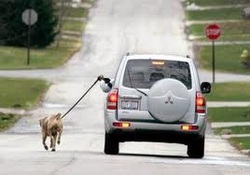
The other day I saw a man walking his dog down the street very early in the morning. He was wearing a bathrobe and literally was walking with his eyes closed. I realized that I knew exactly what he felt like, and I further guessed that there are many common experiences that dog owners share which are special and unique. Here are some of my favorites; please add your own! - The morning sleepy walk. (Most) dogs have no problem waking up super early, if it only means they get fed. Mine is particularly accurate with respect to her internal breakfast alarm; she is rude enough to even start scratching on doors if she's not walked and fed by 8:30am. What a nerve.
You know the morning sleepy walk I'm talking about: Throw on a robe or go out in your PJs; be blinded by the sunlight as you walk out first thing in the morning; check your email while stumbling down the street after your dog; bend over to scoop up any goodies she leaves.
- Begging for food. Some dogs can be polite, and some can be very forward with their food requests. Some will dance, some will do tricks, and some will literally push you to move towards the cabinet where you keep their food. Talk about confidence!
- Salivating on guests. You're hosting a nice, dressy party or just have some guests over randomly. Yeah, great timing for your dog to get worked up and start sweating and salivating all over the place (but that's when it always happens). Saliva on guests, on your nice pants, on the couch, on the floor. Maybe dogs think we like it?
- Being lazy on a rug or sofa and not coming when called. You're running 5 minutes late and need to leave the house ASAP. You realize the dog needs a walk and so you call it down. That's exactly when it's least likely to come; it's snoozing softly somewhere, and it feigns poor hearing until you literally come up and give it the look. Attitude!
- Shaking their whole body after a bath or rain and getting you all wet. Dogs have special muscles in their back meant just for shaking their entire body in rapid succession to maximize the amount they can soak you.
- Smelling another dog's genitals and putting you in an uncomfortable position with respect to the other dog walker. You're walking Fido down the street and some strange-looking (or maybe attractive?) person is walking their dog towards you. After the initial awkward is-this-other-dog-going-to-kill-me check, the dogs start smelling each other's rear ends. Then your eyes meet the other person's, and it's always uncomfortable. Do you make your dog stop? Do you try to smell the other person? Do you apologize? Do you run away as fast as possible?
- Washing and refilling dog bowls. The food bowl, the water bowl, the travel bowl, the dog bed, the dog towel, the dog tag necklace, the dog toys -- all this paraphernalia that requires constant maintenance for one simple creature. How about it take care of itself once in a while?
- Going "shopping" at Petco and thinking about all the toys you would want as a dog and realizing your dog may have different preferences. Petco for me is like a toy store; so much new-smelling, colorful stuff, even snacks that look like human food. I love how they make it pleasant for dogs and humans alike.
- Sneezing when smelling second-hand smoke. While humans have to just put up with it or move away respectfully, dogs can just sneeze loudly and proudly of their hate of cigarette smoke.
- Jumping up on your shoulders to greet you. This is always fun, unless you're carrying something fragile. In any case, it's nice to feel loved and wanted, even by a four-legged creature.
- Rolling onto their back to help facilitate belly scratching. Dogs are so smart; they can calculate and optimize the perfect angle to keep their body to maximize scratching and petting sensation.
- Picking up dog poo and carefully negotiating with the swinging bag surface, keeping track mentally of every surface and bag fold between what's clean and what's dirty. No one wants brown fingers, especially before having to eat breakfast, so figuring out how to do the most delicate maneuvers with a bag of poo is one of the first things we learn as dog owners. The other awkwardness comes when you run into others you know on your way to the trash and have to somehow greet them carrying a bag of poo. Wonderful.
- Playing tricks on you to get you to finish a walk faster and give them food. If I'm trying to get my dog to walk more or poo, I just keep walking farther and farther, and at some point, my dog just gives me this dramatic chipmunk look like, "are you crazy?" Once that fails, it starts to dig its nails into the ground and pull back on its leash. Once that fails, it finally decides to take a few steps onto some grass before immediately swerving backwards and trying to walk home (in basketball, this is a pump fake). This is all in order to come home and get fed faster.
- Understanding situations and coming to comfort you or give you space when you're packing. Dogs can sense very early if their owner is leaving or sad or hurt. It's amazing when they're able to show this level of compassion and how they express it.
- Nuzzling up against you and petting themselves against your legs or hands. Face it: your dog is using you like an object, and you're just its walking, feeding massage chair.
- Snoozing next to you while you're working. This is perhaps the most peaceful and gentle expression of love from a dog, and it's a wonderful moment to appreciate.
I had a lot of fun helping to plan my wedding, and through the experience, I learned a ton about event coordination, business negotiation, and dealing with difficult personalities. It was all worth it, but I just wish it didn't have to be so tough. As I see it there are three general problem areas with the wedding industry right now: 1. Insane prices. The moment you mention "wedding," the tone immediately changes. All of a sudden, the other person is so extremely "nice" and warm, sprinkling congratulations and feigning curiosity into the details of the proposal. They aren't faking their delight, though; they are so extremely happy to have another person they can totally overcharge. Because saying "wedding" is basically the same as saying, "please charge me 50-100% above normal." I may sound a bit cynical, but it's just from being shocked so many times in hearing prices for various everyday things that are out-of-this-world high and which one would never pay on a regular day. For example, with venues, flowers, and invitations, I had numerous experiences of realizing that prices are sort of in their own "wedding universe" rather than based on cost or value add. This price bubble is further heightened and sustained through all the various media that cover the industry and that speak of $100K budgets like they're the new normal. The unfortunate thing is that in this industry, just like almost everywhere else, you get what you pay for, and if you pay top dollar, you likely will get better service than if you choose something cheaper. However, the general magnitude of prices in question is what is so frustrating. I wish vendors were more honest in the sense of not taking advantage of the joy of a wedding and the guilt of not paying for the "best" for one's "most important day" and simply provided great service at a reasonable price. That's obviously too much to ask (though I was lucky to find a select few vendors who did in fact do that with grace). 2. Sub-par quality. You'd think that with high prices comes amazing performance. Sometimes that occurs, but from my limited experience, it's less often than not. Unfortunately, wedding vendors are amazing salespeople who will show you their "best of the best" portfolio instead of their average wedding (like from a recent weekend), and so consumers are making their decisions on the wrong basis. Consumers do have a burden to do proper due diligence, but it would be nice if the industry didn't make their job more diffcult. It's frustrating to have to constantly fight for every "concession," where concession often means simply getting what was originally promised or discussed and which now turns out to be something premium or extra. Sometimes sub-par quality can be even worse, such as when your bride's wedding dress is destroyed by a dry cleaners that decides not to take responsibility for it (yes, true story). It's really unbelievable. 3. Poor ethical standards. This last point can be summed up simply with, " Be a man. Do the right thing." Or more elaborately, be a professional. This means being honest, not needing a contract to spell out every detail of behavior, and doing what you say you're going to do (something I realize most people can't accomplish). In the height of vendor negotiations, I had a long checklist of all the various contract sections that would always need to get added or removed and things to explicitly check in every contract or estimate. Nothing would ever be preset in the "form agreement" that was in your favor or as discussed or "sold" to you; it would all have to get argued to get included explicitly. It's frustrating when someone promises something and yet can't commit in writing. Besides contracts, which few will ever really enforce, actual ethical behavior is what's sorely needed. I remember visiting one cake vendor who rudely scoffed at our requests and said that she didn't want our business but if we forced her she would charge us $x (where x is an order of magnitude more than the next most expensive vendor). We also had one cake vendor who promised to do our cake but then bailed when we wanted to sign a contract ("sorry, got a celebrity wedding"). We even had our DJ bail on us the day before he was supposed to play ("sorry, stuck in Europe [partying]") -- it was a lot of fun hiring a new DJ on my wedding day. I realize this post has somewhat of a ranting nature, but I know I'm not the only one who's felt this pain. It'd be one thing if the prices were low and I were dealing with shady vendors; it's unbelievable when it's with ostensibly high-quality vendors charging ridiculous prices. That really needs to change. People need to step up, and prices need to step down. 'nuff said.
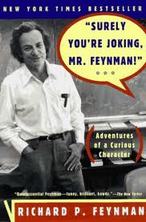
I recently listened to the audio version of Surely You're Joking, Mr. Feynman!: Adventures of a Curious Character by Richard P. Feynman. It was a wonderfully personal, detailed, and amusing account of many of Feynman's famous stories. The book reminded me of several people I know in my own life that bear remarkable resemblances to him; it's curious how certain scientists and nerds can be similar. The book covered some of the stories around the major parts of Feynman's life, starting with his childhood, through his time in working on the atomic bomb, through his winning of the Nobel prize, and on to include his many adventures and misadventures with music, women, Brazil, and lock-picking. His stories were all written in a direct, matter-of-fact tone, the content of which was quite funny. Through the book, I ended up learning a decent amount of history, physics, philosophy, psychology, and about women, strippers, lock-picking, and Brazil. Not bad for one book.... Introduction- Stories about his life and work
- Mischief big part of his personality
- Hated pretention
- Urge to solve puzzles from young age
- Born in 1918
- Went to MIT
- Then to Princeton
- Worked on Manhattan Project
- Married several times
- Finally went to Caltech
- Built science lab for radios when was 11
- Lots of mischief at home
- Built burglar alarm to catch parents
- Repaired radios by thinking
- Has persistence
- Can't ever leave a puzzle unsolved
- "Puzzle drive"
- Learned all puzzles in existence
- Joined algebra team in high school
- Has to see answer in a flash
- Invented problems and theorems
- Made up own trigonometry before learned in school (also Taylor series)
- Made up own symbols for math
- Fixed typewriters for fun
- Had odd jobs during Depression
- Several inventions in kitchen when worked as cook (but got in trouble for them as they didn't work as planned)
- Innovation is a difficult thing in the real world
Part 1: MIT- Joined Jewish fraternity
- Not religious at all
- Didn't know how to be social
- Hazing rituals
- Study-ers and socializers taught each others
- Never good at sports
- Doesn't judge people by look (enjoyed dancing with deaf girl)
- People's knowledge can be very fragile
- Some people "learn," but can't apply what they know
- Learn out of rote memorization (Brazilian physics education)
- Liked to play jokes on waitresses
- He's usually very honest, even when joking
- Loved to listen to Italian radio for melodic language
- Had to go through humanities classes
- Wrote on topics of interest to him in humanities papers
- Astronomy and philosophy
- Analyzed own dreams and perceptions
- Studied self while falling asleep
- Could somewhat control dreams
- Dreamt in color
- Did chemistry magic shows
Part 2: The Princeton Years- Very formal social conventions and dress
- Cyclotron experiments
- Got hypnotized, and it worked
- Sense of knowing he can not go along with hypnosis but going along anyways; isn't that hypnosis?
- Sat around various tables at dining hall to learn from philosophy and biology groups
- Learned biology and phages
- Gave talk to Einstein
- Wanted to be practical, not cultured
- Understands theorems by making up examples in his head
- Interest in mind readers
- Experiments with ants
- Carried magnifying glass around
Part 3: Feynman, the Bomb, and the Military- Wanted to make contribution to country
- Loved to tour Bell Labs
- Got job but left to join military
- Worked on mechanical computer using gears
- Worked on radar
- Smelled bottles and books and realized that human smell can be about as good as a bloodhound's
- Los Alamos from below
- Manhattan project
- Wasn't famous
- Fright over Hitler building bomb before us
- Started to work immediately on bomb calculations (separating uranium isotopes)
- He was theoretical; others experimental
- Had different box of tools than others from the textbooks he read as a kid; differentiating under the integral
- Started building Los Alamos laboratories
- Wife had TB
- Had to go to Albequerque
- Beautiful scenery
- Studied and debated with others
- Letters got censored
- Liked to expose security flaws in system around him
- Repaired mechanical hand calculators
- Used IBM card machines
- Wife died from TB
- Was prepared for the death
- Cared more for work and solving problems and was able to cope
- Von Neumann: don't have to be responsible for world around you; went on walks with him
- Saw Bohr
- Worried more about physics ideas, not about pleasing others
- Saw bomb explosion test
- Had made plutonium
- Went to Cornell to teach
- Learned to pick locks
- Bad paper document security at Los Alamos
- Kept breaking locks to show that they were no good
- Took his new combo lock apart to understand how to break it
- Learned to brute force combo locks in 4-8 hours
- Had to amuse himself somehow
- Picked last 2 numbers from people's safes all the time when visited people's offices
- Must close safe doors immediately after open and take something out (don't leave open)
- Broke all 9 safes containing all secrets of atomic bomb (for fun)
- All safes had one combo: math constant e
- Only way to solve a safe is with patience
- Brute force reduction methods
- Opened 2 safes cold with psychological methods (meaningful dates, etc.)
- Befriended locksmith slowly
- People don't bother to change from default safe combo
- Got medical exam from psychiatry before working at GE; failed psychiatry screening
- Liked to play tricks on people
Part 4: From Cornell to Caltech- Likes teaching in order to feel like he's contributing
- Likes thinking of answers to student questions, improving how to teach
- Taught at Cornell mathematical methods for physics
- Tried to be more dignified
- Went to social dances
- Put a lot of thought into lectures
- Felt burnt out, no ideas
- You have no responsibility to live up to what others expect
- Liked playing with physics, inventing things for own entertainment
- Play with physics whenever want to
- Worked out equations of dishes wobbling
- Effortless playing with things that were interesting
- Diagrams that he won Nobel Prize came from this playing
- Learned to entertain himself in Chicago bar
- Learned to stay in bars without getting drunk
- Accidentally got patents for obvious ideas on nuclear ideas (assigned to government for $1)
- Used his $1 to buy cookies
- Likes to imitate being drunk even when not
- Realized useless to buy girl drinks; don't get anything from it
- Got lessons from MC
- Under no circumstances be a gentleman; don't buy anything until ask if girl will sleep with you
- Must disrespect
- Never buy drink
- Must ask explicitly
- Did mental math by tricks but got lucky
- Memorized logs and e tables
- Abacus allows you to not know basic arithmetic
- He knew lots of approximation methods
- Decided to take immersion class to learn Spanish and go to South America
- Taught physics classes in Rio and went to beach in afternoon
- Learned new customs
- Got married again and divorced because of lots of arguments
- Learned samba drum, joined samba school
- Succeeded in learning frigideira instrument well
- In Brazil, students memorized rather than actually learned concepts
- Visited Las Vegas
- Loved beautiful girls
- Spent a lot of time talking to showgirls
- Visited Sunset Strip
- Hated snow in Ithaca
- Loved Caltech and the weather
Part 5: The World of One Physicist- Would you solve the dirac equation?
- Lots of physicists in Japan came for conference
- Wanted to stay at Japanese style hotel
- Slept on floor, no chairs
- Japanese bath
- Analyzed physics by constantly applying examples in his head
- Different words in Japanese for same concept, varying by politeness
- Felt like always was behind in physics and struggled in understanding new concepts
- Studied beta decay, parity law violations
- Didn't want to give public city college talk if had to give more than 13 signatures
- Learned to draw and studied art
- Feeling of awe in science and glories of universe
- Drew nudes
- Every woman worried about her looks no matter how beautiful
- Sold some of his drawings
- Did physics and drawings at strip clubs
- Sold art and commissioned portraits
- Is electricity fire? (Jewish Sabbath rules debate)
- Didn't like interdisciplinary conferences
- Joked about Sabbath goys with rabbis
- Judging books by their covers
- Joined curriculum commission to rate math books
- He was the only one who actually read all the books
- Books were written horribly with tons of mistakes
- Averaging length of emperor's nose when no one has seen him (bad crowdsourcing)
- Publishers bribed book reviews all the time
- Didn't want publicity and attention from getting Nobel Prize
- Didn't want reception to celebrate
- Brought up to not like royalty
- Thought Prize was pain in neck; wanted to be taken straightforward
- Learned about Mayan math in Mexican honeymoon
- Cracked Dresden Codex himself for fun
- Liked beating drums for fun
- Played music for SF ballet
- Couldn't read music though
- Studied altered mental states
- Loved to think and didn't want to ruin the machine (brain)
- Went into sense deprivation tank to experience hallucinations
- Learned that memories stored according to location of where experienced memory
- "Cargo cult science" = bad science
- From Caltech commencement address
- Esalen baths to study mysticism
- Must have scientific honesty
- Must disclose all facts even those that invalidate your cause
- Complete opposite of advertising
- Must not fool yourself
- Must publish results and advice no matter what result was
I've been lucky enough this year to take two trips out of the country (and one hyper-local "stay-cation" for my anniversary organized by my wife). I enjoyed them all and learned many things, including checking off many items from my "do-before-I-die" list. Below are some of my favorite lessons and memories from these travels. (I also just saw Rio, which I really liked, and which reminded me of all the wonderful experiences I had in South America. I'm also reading Surely You're Joking, Mr. Feynman!, and apparently the famous physicist also loved visiting Brazil and even played the frigideira for a winning samba school.) 1. Rio is sort of like the movie. The samba is loud (got to see a samba show with good music but slightly cheesy/touristy dancing), the people are crazy about Carnival, and the sights are beautiful. (The movie's Rio is definitely cleaner and has prettier birds, though.) 2. The cable car ride up to the Sugarloaf mountain is wild -- such a nice view! 3. The Christ statue at the top of Corcovado is much bigger than it looks. You can take some really fun perspective photos from up there, though. 4. Spanish and Portuguese are close enough. I found Portuguese to be like a melodic version of Spanish; I could get by just turning some ción's into ção's and talking about samba and Carnival (though clearly I'm kidding and there's a lot more to the language). It would definitely be fun to learn it more closely some day. 5. The beaches are beautiful, and they are the spot to be seen during the Christmas holidays. My favorite beach for swimming was in Buzios, a sleepy, less developed part of Brazil (the original home, apparently, of some pirrrrrrates). The busiest beach I've ever seen was in Santos on Christmas Day; it was no less than 10,000 people literally walking up and down the miles-long coastline, sporting their wares (some better than others). It was truly a cultural moment to experience that. 6. Doing tango in a century-old tango studio in Buenos Aires was epic. The creaking wood floor, the raspy Argentine tango record playing in the background with melancholy... it was like I was in a movie. (Having some yummy parilla afterwards is what's required to hit the spot.) 7. Flying is everything I thought it would be. I always dreamed of becoming a commercial airline pilot when I was little, and I got to start towards fulfilling that dream in July. I flew a Cessna from Santa Monica to Point Dume and back with Justice Aviation for a one-hour demo flight (my instructor was named Max too!), and it was truly awesome. 8. Be appreciative for every raspberry you eat; picking them by hand is quite a difficult undertaking. I know: I tried to do it at Underwood Farms, and got so annoyed with it after 20 minutes. Each raspberry has to be picked off by hand, and it has to be ripened just so in order to taste good. I no longer take these little berries for granted. (Another fun thing at Underwood is feeding carrots to the horses and trapeze-artist goats -- no joke!) 9. Biking on July 4th at the beach can be fun and dangerous. We did a bike ride from Venice to Manhattan Beach, which was really enjoyable, except for when the bike path was filled with barbecuing, boombox-toting pedestrians. There was even a section that featured a row of parked Chevy '64s with various "interesting" decorative elements. It was all cool; talk about LA diversity! Other fun stuff from the weekend included seeing the Houdini exhibit (and learning about the history of magic) and eating yummy food at Larchmont Bungalow, Red O, and Geoffrey's. 10. Manatees are the sweetest marine animal weighing close to a ton, and they're in extreme risk of extinction. (Turtles are the sweetest marine animal weighing closer to tens or hundreds of pounds.) I had the pleasure of swimming with (and kissing on the lips!) a manatee, dolphin, and sea lion in Mexico, and it was amazing. Learning about these creatures and watching how smart they can be was really inspiring. It was very sad to learn that 60% of manatee deaths are due to human causes like pollution or plastic bags getting eaten by them and poisoning them (they're dying less from natural deaths than from us!). I also learned manatees don't really have teeth and don't really bite; their color, size, and demeanor reminded me of my previous Neapolitan Mastiff, Marcello. (I also got the chance to swim with stingrays and a nurse shark with apparently no teeth as well -- not sure I believe all these "no teeth" tourist stories, but I'm thankful to have gotten out of there alive.)
 TheNextWeb There is a well-known Russian saying: "Love is not a potato." The first time I heard this, I thought it was ridiculous. It's like thinking you're smart by stating something completely obvious, like 2 + 2 = 4. However, I've grown to love this saying over time. I love its extremely simple language that can be understood by anyone. I also love that the more you think about it, the more you realize it means. I recently had a long, late-night discussion (with my avid commenter "S") of all the meanings to the saying. Below are what we came up with. 1. "Love" and "potato" are very different objects and concepts. This is the base, "obvious" level of interpretation. 2. You can easily throw away a potato (if it's bad or if you don't like it), but you can't easily throw away love. (This is my mom's interpretation.) 3. Potatoes are easy: skin (optionally) and bake. Love is not easy. It takes a lot of work. 4. Potatoes are pretty much homogeneous. Yes, there are lots of varieties of them, and I'm sure no two potatoes look exactly the same. But my sense is that there are way more varieties/qualities/types of love than potatoes. 5. Potatoes are static. You park one on your kitchen counter, and it will sit for as long as you want. (Yes, it will rot after a while, but that's very slow and gradual.) Love is not static; it is constantly changing and evolving. 6. Potatoes are a staple: a very simple, everyday food item. Love is not a staple; it is unique and celebrated every time it occurs (weddings, anniversaries, Valentine's Day, etc.). More on celebrations later (apparently, people celebrate potatoes too). 7. Potatoes are finite, concrete objects. Love is infinite, a concept. 8. Potatoes have pretty much one dimension. Love has many. 9. Potatoes are easy to mold and fit to your recipe. Love is not easy to mold and takes a lot of care in "harvesting." 10. Potatoes are a side dish. Love is the main course. 11. Potatoes must be salted, or else they're bland. Love is amazing as is. 12. Potatoes have many " eyes." Love is blind. 13. Potatoes have an expiration date. Love (hopefully) does not. 14. You pick the potatoes you eat. Love, more often than not, picks you. 15. Potatoes satisfy the lowest level of your needs on Maslow's hierarchy. Love satisfies needs that are 2 levels higher up the pyramid. 16. You can't make potatoes (nature makes them). You can make love. 17. Finally, thinking about the saying at a meta/philosophical level, it seems similar to Magritte's image of a pipe. "This is not a pipe," he writes. "Love is not a potato." It is an image of a potato. (?)
After coming up with this list, we realized that this was somewhat of a stupid exercise. We wondered what object in fact could be more different from love than a potato. Thinking about that made us actually realize that love and potatoes, after all, have a lot in common as well: A. People have fought over both: potatoes and love. B. Both can go stale if left untended. C. Both have holidays: potatoes and love. D. Too much of both can be bad. E. Both are best when hot and sizzling. F. You can crush both if you try. G. Both can be enjoyed by many people together (sharing potatoes over a meal, sharing a sense of joint love in a family). What is your interpretation of all this nonsense?
I recently finished listening to the book I'm Feeling Lucky: The Confessions of Google Employee Number 59 by Douglas Edwards. It was quite a long, detailed story, but I particularly enjoyed that level of detail, as hearing the "inside story" was what I was actually interested in. I learned about Google around 2001, when a friend showed me a search engine he claimed worked better (and faster) than Yahoo (that's when they were just showing the milliseconds to complete a query, which they still do to this day). When I got to college, I had friends who worked at the headquarters and even invited me there for meals (it was like going to Disneyland). It was really neat hearing the detailed account in this book from an insider and correlating that with my own personal experiences of the company and people I knew there. The story was written by a journalist who was tired of working at large corporations and wanted to experience the start-up life. He became Google's Brand Manager and continuously struggled with his own identity in the company and what his role was. It was humbling to hear about the internal politics and constant debates that took place between the initial members of the company on issues all over the board, like product features, EULA language, April Fool's jokes, logos, and UI design and copy. I felt like I could relate to the author because I too have experienced these types of debates and have felt similar frustration to his in the past. Overall, I learned a lot more about Google and the bumpy, windy road it took to where it is today. It's so easy to think they had everything figured out from the beginning; this book explains that there could be nothing further from the truth. Below are my main notes and takeaways from each part. Introduction- Started out complete opposite of a large corporation
- Operating principles: old rules didn't apply
- Was there 1999-2005
- Worked in marketing
- Brand actually built by engineers
- Yahoo was juggernaut but portal
- Google: obsession with efficiency
- Efficiency, frugality, integrity
- Joined when there were 50 engineers
- He was #59
- TGIF Weekly Meetings talking about accomplishments for the week
- Status blind culture (but engineers #1)
Part 1: You are one of usCh. 1: From whence you came- Came from marketing at San Jose Mercury News
- Tired of big co. bureaucracy
- Huge dot-com bubble
- Google: huge focus on equations and algorithms
- Sergey interview question: after he comes back in 5 minutes, explain to him something complicated that he didn't know
- Started as online brand manager
- No org chart in company but they had a chef and massage therapists
Ch. 2: In the beginning- Not clear what business vision was
- Focus on collecting smart people; figure out plan later
- Everyone volunteered in data center
- Global shortage of RAM
- Build machines to fail; use commodity parts
- Fix and replace later
- Crazy stories of mayhem inside data center
- Decided PR main method of marketing
- Little plan in marketing
- No structure of management
- Yahoo switched from Altavista to Inktomi, a Google competitor
- Inktomi did all search around web
- Go2 used free market to do bidding-based ranking
- First project of his: codifying UI
- Data-based divinity at Google, which he wasn't sure always made sense
- Not sure why he was there
- TGIF tradition: celebrate employee birthdays that week with cake
Ch. 3: A world without form- Crawling
- Indexing
- Ranking
- Query analysis
- Anchor text analysis
- Disambiguation
- Speed vs. scale
- Focus on hiring only those as good as you; only way to double your productivity is to hire another person as good as you
- Mission to collect all smart people in world
Ch. 4: Marketing without marketing- Google always believed product more important than marketing
- Sergey wanted to give donation against cholera to gain awareness
- Never want to take standard or approach
Ch. 5: Give a process its due- Sort of sarcastic tone throughout book
- Kept wanting to do marketing but kept getting pushed aside
- Wanted to create product management group but faced resistance
- Google mantra: Just build cool stuff for its own sake
- Created OKR (Objectives & Key Results) system
- Products died by data alone, not sentiment
- Supposed to complete only 70% of OKRs
- Performance reviews separate from OKRs
- UI team growth and many debates
Ch. 6: Real integrity- Decided to experiment with ad platform that is heavily targeted
- Started with Amazon affiliate ads, delivered first revenue of company
- Tried out selling CPM ads
- Built inventory estimation system
- Wanted to only do text ads to not be intrusive
- Added color backgrounds to distinguish from search results
- Decided to move to CPC ads determined by realtime auctions
- Key difference was that they targeted keywords, as opposed to only the auction results like Go2
- Real ethical dilemma: pay for placement made founders angry
- Engineers cared about quality and ethics
- Search engines need to watch out for public by not letting people manipulate results
- Came up with term, "Don't be evil"
- Google Open Directory project versus search
- Volunteers added sites to directory
- Barter arrangements to swap ads to Google with other networks
- Wrote own banner ads when didn't hire freelance artist (hated hiring outside contractors, especially designers or ad agencies)
- Analyzed ad performance using data alone
Ch. 7: Healthy appetite for insecurity- Author had insecurity about his own value
- Age 41, wife, 2 kids, unsure about what he's doing and why working long hours
- Self-doubt is always linked to ambition
- Google had leader boards internally for all sports and work
- Developed coding style guide
- Compiler warnings should never ignored
- Formal code review practice
- Elevated standards
- Cross-pollinated ideas over meals
- All perks and services provided
- To make decisions when people fought, had to duke it out in a video game
- Charlie was chef from Grateful Dead
- Emailed different menu every day
- TLA: three letter acronym
- Free food policy increased collaboration and saved employee time
- Made sure nothing went to waste
- Webcam monitoring cafeteria line length and servery conditions
- Cafe became circus with celebrities who visited over time
Ch. 8: Cheap bastards who can't take a joke- Philosophy: launch first then iterate
- Created product review meetings with Larry
- April Fool's joke designed for site
- Mentalplex: Google searches when you think
- Joke of putting nav text in foreign language went bad, users complained, engineers didn't follow spec
- Learned that engineers are the true gatekeepers
- Hyperbolic ideas of founders
- Called competitors and press "bastards"
- Feedback always ambiguous: "think about it more," "not too sucky," "not Googley"
- Philosophy: Never pay retail
- Overpacked office with staff
- But then got SGI office
- Negotiators obsessed with cheap and getting discounts from vendors
- Put vendors on phone conference together to compete
- Expected 80-90% off list price
- No one talked about salary, just options
- Had to borrow money from parents to exercise options when granted for tax reasons
- Always put boss's idea as priority
- Larry killed marketing budget and focused on affiliate program
- Killed program when data didn't support
Ch. 9: Good enough is enough- First Google Doodle of aliens
- Didn't think logo changing was good for brand
- Google makes you challenge every assumption
- Don't delegate, do all you can yourself to move forward
- Never stop others from doing something interesting
- Don't get in way of others doing something interesting
- Logo doodles became controversial
- Pressure from kids and family
- Pressure to perform
- Good enough is good enough
- Get 80% of a task done and then it becomes lower priority, so should switch to another task
- Hire based on ability over experience
- Google generalist hiring
- Everyone very sparse with praise
- Never derail launch of product for marketing reasons
- Patch and move on rather than fix underlying issue
Ch. 10: Rugged individualists- Larry hated ad agencies, thought they were evil, stupid people
- Product should stand for itself
- Believed in simplicity as a benefit
- Must focus just on tech
- Larry read business books to prepare to run his company
- Founders set the terms of their VC valuations
- Never self-aggrandized
- Ideas valued based on merits, not source
- "Misc" email list with long funny threads
- Engineers don't stop asking why
- Don't let something go by when see something wrong
- Fight over everything
- Lots of unsolicited advice (sounds like Israeli culture based on Start-Up Nation)
- Founders always had laissez-faire style
- Listened at meetings, but let others decide
- Fought with data when cared
- Porn filter was difficult work
- Porn is a cutthroat business heavily using tech
- Learned about spammers that deceive search bots
- Google employee spoke on forums to correct rumors, could speak freely without PR approval
- Shut off unauthorized automatic queries, even to entire ISPs and countries (France) when had no other choice
- Spend time doing not deciding
- Individual engineers just do what they want
Part 2: Google growsCh. 11: Liftoff- Not start-up and not search behemoth
- Awkward time
- Extremely long hours
- Became Netscape's default search engine
- Huge increases to server load from user growth way more than expected from Netscape
- Created pager service to monitor site after went down a couple times
- Couldn't add capacity fast enough
- Yahoo switched to Google
- Had contractual obligations on latency and index freshness (promised way more than could deliver at the time)
- Made them push hard to improve
- Problems with bad hardware and memory
- Had to write resilient code
- 1 billion URL indexed goal
- Built Google 2 infrastructure
- Made index format a lot more compressed
- Started ignoring the word "the" on pages
- Daily re-ranking and indexing much harder
- Incremental indexing huge problem
- Incestuous interconnected Silicon Valley companies
- Job hopping expected
- Office relationships and politics
- Larry and Marissa became a couple
- "Mixed marriages": spouses at competitor companies
Ch. 12: Fun and games- Company camping trips
- Idea: ad self-serve
- No rules at all on filters, worried about it
- Have to love uncertainty to be in a start-up
- AdWords creation
- Was his name ("Edwards")
- Initial customers: lobster company and porn
- Injected humor into error messages and FAQ
- Developed Google voice
Ch. 13: Not the usual yada yada- Google Toolbar privacy issues
- Talked about privacy up front
- Engage privacy explicitly
- Message said, "This is not the usual yada yada"
- The more you inform people, the more they trust you.
- Promoted to Marketing Director
Ch. 14: Google problems and mail fail- Focus on search quality
- 10k machines dedicated to search quality
- Anchor text analysis
- Google bombs: weird results
- Huge customer service and email backlog
- Google acquisition of usenet company DejaNews
- Users rebelled but Google ignored because were actually helping them
- Vision of founders burned brightly and always ignored initial public reaction
Ch. 15: Managers in hot tubs and hot water- Annual ski trip
- Shared all financials weekly with team
- Needed to find CEO to go public
- Eric became CEO
- Focus on cost cutting
Ch. 16: Is New York alive?- 9/11/01
- Downloaded news articles and put on homepage without asking anyone permission
- People kept requesting them to add news links
- Not a soulless corporation
- Did whatever they could to help
- Sergey injected own personality into company
- Searched logs to help find terrorist names
- Had to go on instinct as added news sources
- Struggled with tone with users
- Worked on algorithmic news
- Controversy on showing US flag, mourning message
- Went back to focusing on functionality, not content portal
Part 3: Where we standCh. 17: Two speakers and one voice- Disagreements with Marissa Mayer
- Engineering just did what they wanted
- Larry really wanted to scan books
- Started with mail order catalog scanning
- Was tough
- Launch calendar meetings
- Approvers of various parts had to flip approval bit on project page
Ch. 18: Male enhancement- CRM software update couldn't be installed by themselves
- Instead of getting reliable CRM vendor, invested in Larry's friend's CRM startup and then bought it
- Translation Console to translate services to other languages
- Crowdsourced translation of site pages
- Google way: break things into tiny solutions
Ch. 19: The cell of a new machine- New system for AdWords using CPC not CPM
- Distribution of ads on others sites
- Epiphany: CPM * CTR based on quality ranking using historical data and other inputs
- CTR needed to be predictive and used black box/secret algorithms for ad scoring
- Second price auction model better than Go2's first price auction
- Care about best results for users, not advertisers
- Larry and Sergey were never much into the ad project
- Go2 changed name to Overture, which believed all search results will eventually be paid
- Endless struggle for search perfection; list of 10 principles; not portal
- Focus on user
- Do one thing well
- Fast is better than slow
- Open is better than closed
- Democracy works on the net
- Don't have to be at your desk to work
- Can make money without being evil
- Always more info out there to organize
- Need for information crosses borders
- Don't need a suit to be serious
- Great is not good enough
- Underpromise and overdeliver
- Tech company that solves hard problems
- Don't be evil
- Overture got Yahoo ad deal (juggernaut deal)
- Google got Earthlink ad contract
- Running own site was lab for advertising
- Lowered margins on distributed ads so partners on other sites could keep a lot more revenue
- Overture took 49% of revenue, so Google could undercut them by subsidizing through revenue off ads from own site
- 35 engineers reporting to 1 PM
Ch. 20: Where we stand- Company vision: products that are work, are useful, and never evil
Ch. 21: Aloha AOL- Aol was giant of Internet, partnered with Overture
- Approached AOL for business
- AOL very hard negotiator
- SWAG: Scientific Wild-Ass Guess
- Had to calculate guarantee payment to AOL if didn't get any ads clicked
- Thought had lost Yahoo and AOL deals to Overture
- But deal not yet final
- AOL canceled deal and did deal with Google
- Hired lots of AdWords reps, temps
- Lots of women hired (engineers got happy)
- Built up ad network bigger than Overture
- Focus on objective search results
Ch. 21: We need another billion dollar idea- Introduced Associate PM and Product Marketing Manager positions
- Started becoming big company
- Google Logic: his brand identity idea
- Not well accepted
- No one cared about messaging strategy
- Next billion dollar idea: Gmail
- Thought would never do ads on email content
- Founders more open to it (just like spam filters/analysis)
- Used content targeting for ad results
- AdSense
- Shared revenue with publishers
- Project of moving all offline content online (started with books online)
- 20% time concept came out of this prototyping that wasn't assigned
Ch. 23: Frugal and friction- 7-8 moves of his desk in 3 years
- Became Director of Consumer and Brand Marketing
- Marissa always prevailed in debates
- Froogle launch
- Wanted to use Google Product Search but overruled
- But won tagline battle
- Eventually named changed to what he said
Ch. 24: Don't let marketing drive- Pop-up blocker in toolbar
- Privacy versus usability
- User search data on cookie/IP address combo
- Larry wanted to minimize public discussion of privacy and queries
- Google Zeitgeist
- Display in lobby of live searches (I remember that!)
- Strain in relationship with Marissa
- Marketing cast out of product review meeting
- Passed 1,000 employees
- Coordinated TGIF meetings introducing new employees, milestones reached, revenue
- Cash bonuses to employees
- Yahoo bought Overture
- Microsoft awakened to Google search
- New recruiting idea: billboards with coding challenges inside ads
- Google Labs, Google Aptitude Test
- Used Crispin Bogusky ad agency for recruiting ads
- Googlers came up with the puzzles
- Press loved it, got Simpsons cameo
- Got 4,000 job applications
- Only hired 1 engineer through it directly because didn't have data to track
Ch. 25: Mistakes were made- Bought SGI headquarters
- Fully vested options now
- Huge whiteboard of joke Google world takeover plans
- Intranet kept growing and had ton of data
- Slowly got locked down
- Preparation for IPO
- Yahoo dropped Google from search results but wasn't a problem
- Slips of information to press
- Orkut joined Google, created social network
- Invite-only
- Used Microsoft-based tech at first and then moved to Google tech
- Wanted to launch more quickly, skipped security review
- Users started spamming it
- Still huge in Brazil
- Google just let it die instead of working harder on it
- People internally found lots of problems in Gmail
- Bought Gmail domain
- Launched Gmail on April Fool's but was a mistake
- People freaked out over privacy (Google reading emails)
- Writing S1 document to go public
Part 4: Can this really be the end?Ch. 26: S1 for the money- RR Donnelly editing firm in Palo Alto reviewing S1 line by line with 20 lawyers
- Company meeting announcement of IPO plan
- Google wanted to do Ddutch auction which banks hated
- Everyone had laid back attitude; no one cared too much
- IPO not big deal
- Everyone kept working
- Worked to keep culture the same
- A few people started buying toys
- Had first earnings call
- His role in brand management not needed anymore
- Would wind down work after 2 months
- Thought founders sometimes too impatient, too proud
- Founders thought they never were wrong (he disagreed)
- Overall, had crazy ride and changed his life
 Sassy Minx I love chocolate. A lot. I've been lucky to enjoy a few interactive experiences where I got to enjoy chocolate on a whole 'nother level. Here they are below; let me know what you recommend I do next! - Baking Ghirardelli Chocolate Caramel Turtle Brownies at home. OK, OK, so this is from a mix, but it's still heavenly good. Plus you feel a sense of accomplishment, and the food subjectively tastes "better" from the sweat you put into it.
- Chocolate tasting at Compartes. This is a chocolatier in L.A. that does all homemade stuff; I got to do a tasting there as surprise birthday gift. It's fairly high end (and unfortunately pricey), but it did taste really good. I remember getting to taste some very odd-flavored truffles, like blood orange and pumpkin, which tasted quite interesting. This place is also known for their custom-made sculpted chocolates. I once ordered a chocolate cell phone for my dad as a birthday gift. (Un)fortunately, he couldn't take any calls on it, but it did taste good.
- Chocolate and wine tasting at Waterford in South Africa. I wasn't really into the wine, but wineries are always beautiful and peaceful places to visit. The chocolate, though, was great, and I managed to trade some of my wine for some extra chocolate, which seemed like a win-win for all involved.
- Self-guided chocolate tasting walking tour in Paris. I read an article (in LA Times Travel, I think) before my last trip to Paris about a journalist's trip to "research" chocolate in Paris. (I did some similar "research" on crêpes after my freshman year at Stanford.) I loved how the article ended with the author agonizing over which of 2 desserts to order from a restaurant menu; she decides to order both because life is short, and she's in Paris. (That's become somewhat of a guiding philosophy for me day-to-day.)
So when I went to Paris, I decided to research and hit up some boulangeries and pâtisseries of my own. I can say it was a lot of fun, and I could easily fill a complete day's menu (calorie-wise at least) from dessert shops alone. There are even a couple companies like Chocolah that specialize in doing specifically these types of tours.
- Cadbury factory tour in Dunedin, New Zealand. New Zealand is calm, quiet, and full of sheep, and Dunedin is no different. However, they do have something the other more bustling cities do not: Cadbury! I felt like I was walking into Willy Wonka's factory, and it was fun and tasty. Plus, every grocery store and gas station sells Cadbury at bargain-basement prices, so we definitely took some for the road.
 itb.biologie.hu-berlin.de A few days ago, I was trying to remember a line in a song I had heard about 9 months ago. I heard the song at a karaoke event, and the singer had a funny accent and demeanor. I vaguely remembered the line contained an alliteration, and with that clue, combined with the funny accent, I was able to remember the moment after about 30 seconds of thought. It was those 30 seconds that then caused me to wonder how my brain did that. First of all, I was quite surprised I even could conjure up the memory, which was quite unimportant. Thus, the fact that I could do it in 30 seconds was surprising; however, why did it have to take 30 seconds? What was going on inside my skull? Was some huge table being scanned? Some map-reduce operation being done? Were old neural connections being dusted off and re-energized with electrical current for my old memory to be resuscitated? What's neat is that our brain consolidates memories and continues to work on solving problems and answering search queries while we sleep. What's crazy to wonder about is what part of "us" controls it while we sleep.... As far as I know, the brain doesn't operate at a typical "clock speed" like computers do (where the clock speed dictates how often a CPU goes from instruction to instruction). But what does control how quickly our brain works? Clearly it changes in speed and function over time as we age, and its speed can deteriorate with various diseases. So there must be something biological/physical that somewhat resembles clock speed. IQ? From a quick search, this article tries to tackle this question, but at a very high level (and the article's somewhat old). That got me thinking about another clock in our body, something a lot more like the clock on our wall and in a computer: our body's internal clock (circadian rhythm). I bet there are lessons both biologists and computer scientists can learn from each other in examining the parallels between our body's clock, our brain's "clock," and our computer's clock. And finally, how does parallel processing work? In a computer, it's like having separate little brains that can do very basic tasks like read and store numbers and arithmetic; but in our brain, is it that multiple neural connections are being formed continuously and it's just a matter of which ones happen to grasp our attention at any one time? As far as I know, people aren't really able to take a large problem, split it up into many parallel parts, and assign those different sub-problems to separate mini-brains. Or are we? Is that what intuition does? Or does intuition just leap ahead magically to some final answer and not worry about sub-problems at all? All of these questions fascinate me and make constantly wonder how our brains function deep inside.
I recently was lucky enough to attend a sold-out, uber-geek event featuring the creator of PHP, the programming language powering a couple small websites out there, including some you may have heard of, like Yahoo and Facebook. The talk was put on by LAPHP, and the speaker was Rasmus Lerdorf. The topic was "PHP in 2011," and it discussed how PHP fits into the current technology stack, followed by an overview of what you should and shouldn't be doing, along with a summary of new and upcoming features in PHP 5.3 and PHP 5.4. Rasmus Lerdorf is known for having gotten the PHP project off the ground in 1995 and has contributed to a number of other open source projects over the years. He spent 7 years at Yahoo and has since worked for and consulted with various startups. He was born in Greenland, grew up in Denmark and Canada, and has a Systems Design engineering degree from the University of Waterloo. The full "slides" for Rasmus's talk are here. From the moment I found out that PHP is a recursive acronym (standing for "PHP: Hypertext Processor"), I found the language cute. While I personally feel the syntax leaves much to be desired in terms of prettiness, the language clearly gets the job done. Below are my main observations and notes on the talk. Rasmus Background- Rasmus seemed like a very approachable and down-to-earth guy. Definitely doesn't flaunt nerd celebrity status.
- Not traditional hacker background
- He doesn't even have CS degree.
- Likes solving problems, not writing code
- Hated repeating code
- Wrote PHP to program less and enjoy his weekends
- Wrote language to be functional and easy to grasp
- Web programming was never sexy for good programmers
- Thus, non-technical people had to build the web.
- Made it very easy to just add PHP tags to existing web pages and make them dynamic.
- Wrote documentation before wrote code
- PHP written in C
- Was always speed freak; hated slow calls to perl interpreter
- Wanted to embrace architecture of web: store nothing/stateless approach
PHP Background- Mosaic first graphical web browser came out; start of real web
- 1993: Started with basic templating system using HTML comment tags
- Used yacc and lex to write PHP v2
- 1995: Introduced <? tag (process instruction from SGML)
- Others said should label his tag (forgot to read that part of SGML) so now <?php. He likes to read only as much to feel like he understands and then moves on (sometimes not the best practice).
- 2003: added classes/OO
- PHP has 1/3 of web market share
- Only .NET close to PHP in market share
- Yahoo switched all to PHP in 2002 across thousands of servers; stateless design allowed parallelization
- FB using PHP
- PHP did not allow you to modify web server like mod_perl so could be shared on ISPs (important for adoption)
- Limiting CPU time, file system access were other strategic features for ISP growth
- Added 5 second Atom parser to print XML content in 1 line
- Geocoded Twitter search example
- Worked at Yahoo for 7 years
- Created YQL: Yahoo Query Language: like SQL selects from various web APIs
- Geocoded Flickr photos example
- New CSS: shadows, rotation of divs, rounded corners example
On his mind for 2011- PHP 5.4
- Continuous integration
- Node.JS and PHP
- Libevent
- ZeroQM: message queuing
- Gearman worker management in PHP-FPM: offloading jobs to other processes to run in background
- Getting a "real" job :)
- Rewriting 10 year old presentation system
- He also helps startups get going well on PHP
Technologies serving tech (what he sees in the field)- MongoDB, MySQL, Couchdb
- Redis, Gearman, Memcache, ZeroMQ
- Mod_PHP APC, PHP-FPM APC
- Apache, nginx
- Linux
- Recommends nginx and PHP-FPM
- Sees a lot out there: nginx for load balancing frontend, Apache for web server
Performance- Doesn't matter which web server you choose
- Latency and throughput both roughly stable
- Other stuff you do in generating dynamic data much more important
- Set error reporting to -1
- Use strace, look for ENOENT (should never happen)
- Look at stat cache to see if fills up
- Use a profiler, callgrind, xdebug
- Use "Inclued" tool to see a picture of include files
- Use Hiphop-PHP to do static analysis (Facebook's compiler for PHP to compile to c++ through g++). Can tell Hiphop just to analyze through --analyze flag to find undeclared variables and dead code.
Recommendations- Put static assets on different domain/subdomain for CDN
- Keep cookies short and remember MTU size (max transmission unit for 1420-1500 bytes on TCP) for mobile. Includes all headers, so after headers maybe 600 bytes left.
- Don't overload web servers; don't set max serving to 200 (he never goes above 50-60 servers running no matter how beefy of machines; better to just add another machine)
- Use out of band processing: Gearman or custom via ZeroMQ (he prefers Gearman)
- Don't move relational data out of relational database
- Do move huge non-relational tables out of relational DB
- Be very careful about foreign keys. Avoid if possible. Can create deadlocks easily.
- Think hard about ORM, caching strategy
- Get on PHP 5.3
- Tie cookies to www domain
- Use other domain for all static content (helps w/ CDN)
PHP 5.3 features- Better stack
- Constants in read-only memory
- Better exception handling
- Performance improvements
- MD5 faster
- 5-15% overall faster
- Added closures, namespaces, late static binding, garbage collector, nowdoc, restricted goto, ternary shortcut, __dir__, __callstatic, dynamic static calls, improved date extension, date create from format, better date error reporting, spl, FPM, OpenSSL improvements
- His secret: he likes to turn off the garbage collector because he's 1337 and still programs in vi
PHP 5.4 performance improvements- FastCGI request handling, better memory handling, startup/shutdown, repeated run-time function binding, string constants, access to global constants, access to static properties, empty hashes, @ operator, unserialize(), removed features, traits, short array syntax, function array dereferencing, binary notation, improved errors, json improvements
|