
Max Mednik

  • Home
  • Résumé
  • Interests
    • DJing and Music
      • Reading
        • Photography and Film
          • Psychology and Self-Improvement
            • Spirituality
              • Travel
                • Sports
                  • Romance and Weddings
                    • Magic
                      • Community Service
                        • Scuba Diving
                          • Theatrical Lighting Design
                            • Cirque du Soleil
                            • Contact
                            • Search
                            Old People: Mean or Funny 06/30/2011
                            0 Comments
                             
                            Picture
                            It seems to me like people who are considerably older than me almost always fall into one of two categories: being mean or being very funny. No matter what though, the key is that they can get away with anything (like kids). Why is that?

                            By "mean," I don't mean they're always unpleasant. It's just that they're more often than not grumpy or not too sociable. Why is that?

                            By "funny," I don't mean they're always comedic. It's just that they have stories that are genuinely humorous and observant of something common and quirky among us all.

                            In both categories, older people can also be "weird." By that, I mean somehow exotic in their interests or behaviors and maneurisms. Maybe that's from spending a lifetime "finding themselves" and figuring out how they want to be. Or maybe not.

                            Sometimes, older people are very wise. Wisdom is often some combination of all of the above: seriousness and a sense of humor, backed by years of stories and experiences.

                            I'm most impressed when I meet someone who is really fully mentally present and just sharp as anyone half their age. That is truly the most remarkable and special, and I wonder why. What's their secret? How can I grow up and still be quick and "with it" (I like seeing older people with iPads and knowing more about the latest bands than I do)? Why aren't more people like that naturally? Seeing people like this always inspires me (even though it also creates quite a cognitive dissonance).
                            Add Comment
                             
                            Startup Diaries of Anke Audenaert and Carole Ference 06/28/2011
                            0 Comments
                             
                            Picture

                            Anke and Carole spoke about entrepreneurship and their own personal stories in my class by Mayor Riordan, and it was neat to hear two different perspectives on the entrepreneurial process.

                            Here are their quick bios:

                            Carole Ference is Executive Vice President, Business Development of Nielsen Advertiser Solutions, Founder of IAG Research, and Former Publisher of House Beautiful, Connoisseur, and Town & Country.

                            Anke Audenaert is a founder and head of product and research of JumpTime, a company that focuses on building traffic optimization software for digital publishers.  The Culver City based company is 4 years old. Earlier, Anke worked at Yahoo!, as head of market research and network optimization. She is also an Adjunct Professor of Marketing at the UCLA Anderson School of Management and teaches web marketing and analytics in the FEMBA program.

                            Ideation

                            Anke started her talk by speaking about her "aha moment." She started at Unilever and then moved to Yahoo as Head of Research. Her focus was on finding ways to move homepage visitors to the most profitable parts of the site. She realized there was a need for this across companies and decided to leave but first partnered up with someone. She had the algorithms, and she partnered up with Michelle DiLorenzo for Business Development. Together they built JumpTime, a traffic optimization software company. They put a price tag on all content pieces and then build software to move traffic across them. They have 12 employees and have several large clients already.

                            Carole originally started in magazine publishing and moved to TicketMaster here in California. She wanted to change her lifestyle, and so she networked and met people who became her partners. The business idea came from someone else: TV advertising effectiveness measurement. Her company's focus was on measuring viewers' recall and liking of ads. They wrote a small business plan and pitch and went out to GM and Kraft and got lots of feedback from them, tweaking the product until it was in a state that could work.

                            Next Steps

                            Some of the initial steps mentioned were writing a business plan and marketing plan. Anke also started consulting for clients and developed her model further. She analyzed data with her husband Lustig, a famous asset pricing professor, and got together with her future CTO Andres Rodriguez from Stanford Research Institute. Together they set their mission, including lofty goals for the next 5 years.

                            She urged us to write business plans for ourselves and our business, not for getting money. Key points to focus on are goals for product, including specific milestones, and goals for sales (top 50 clients, big companies, etc.). She started a huge Excel sheet to track all this, helping her get her Series A funding.

                            Funding

                            Carole spoke a bit about friends and family funding for her company, IAG Research. She explained that your plan will change considerably from investor feedback.

                            Personal Qualities of Entrepreneurs
                            They must embrace chaos and benign neglect (letting people run with ideas), not being afraid to make mistakes.

                            They must embrace their competition, like Yahoo switching its search engine backends. They must really articulate their product's benefits when they dealing with competitors. They must not listen to people who say something can't be done and that there are competitors.

                            Current Landscape
                            Both ladies said now was a good time for entrepreneurs with "money flowing." In 2010, VC rose to $22 billion, and in 2011, 76% more is expected. The hottest areas they mentioned were the following: Consumer, Mobile, Social, and Health. Various incubator programs they spoke highly of were the Start-Up America Partnership, YC, and IdeaLab.
                            Add Comment
                             
                            The sale starts when the customer says no 06/25/2011
                            0 Comments
                             
                            Picture
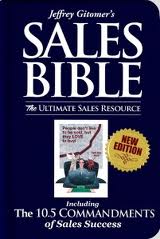
                            I just completed my second Jeffrey Gitomer book: his Sales Bible. I can definitely see his style of numbered lists, with an extra "0.5" at the end at all times, and his intense energy and enthusiasm for sales philosophy came through strong in the audiobook. At times, the text seemed to lack structure and direction, and I felt like there was a lot of repetition. However, buried in this tome are a lot of great nuggets and sample scripts, clearly developed after a lot of field testing.

                            It's interesting how many of the sales techniques presented link closely with the principles of psychology from some of the other books I've recently been reading.

                            Below are my main notes and lessons from each section.

                            Think: the sale is in your head
                            • Walk in with the feeling of certainty, that your product is the best value
                            • Listen to inspirational messages
                            • Pump yourself up
                            Believe
                            • In your company
                            • In your product
                            • In yourself
                            • And that the customer is better off buying your product from you
                            Engage
                            • Develop rapport
                            • Ask people where they live, where they grew up, where they travel, how they landed here, how they got to this career
                            Discover
                            • Find their reasons first; why they buy is much more important than why you need to sell
                            • Find out why others buy
                            • Learn from customer wisdom (ask past customers why bought from you)
                            Ask
                            • The right questions
                            • Get them to reveal value and benefit of ownership
                            Dare
                            • Chutzpah
                            • Cold calls
                            • Asking for something
                            Own
                            • Know whose fault it is when the sale not made
                            • Always your fault
                            • Learn from it
                            Sell for relationship, not commission
                            • You "earn" a sale, not make it
                            Prove
                            • Testimonials are huge; use video
                            • Make them specific
                            • Use them on site, in sales visits, with proposals
                            Become
                            • Daily work towards big goal
                            Values and techniques of the sales professional
                            • Create difference
                            • Know the difference between satisfied and loyal
                            • Ability to speak and be compelling
                            • Stay a student everyday; apple a day of learning
                            • Friendly relationship
                            • Humor
                            • Creativity
                            • Ask for the sale
                            • Believe in yourself
                            • Be prepared
                            • Don't whine
                            • Yes attitude
                            • Set and write down goals on post it's on mirror
                            • Positive attitude

                            Customer management
                            • Add value, ideas to prospect instead of just following up routinely
                            • Show testimonials like crazy
                            • Present just facts, no fluff
                            • Ask personal, deep questions about awards, history of customer's company, goals, family; use these to sell to
                            • Be friends with customers
                            • Call people, add value, do things that are not selling to them at all
                            • Take them to events, outings
                            • Join a business council where you can sell to each other
                            • Your current customers are your best prospects
                            • Use humor
                            • Listen to affirmations

                            Meetings and questions
                            • Answer people's deeper, underlying questions and concerns that lead to close
                            • Ask, What do you look for? What has been your experience? What did you like about it?
                            • Power statements: Sell value to user, not value of product
                            • Develop an elevator pitch with clear call to action
                            • Study the other person deeply beforehand
                            • Cold calls in person or phone: ignore no soliciting signs, ask for help, ask for some passive info, say want to leave some important information, ask who decides on this sort of stuff
                            • Carry article about you, testimonial video, give referral to customer they can talk to, keep a list of loyal customers big and small
                            • Craft words carefully
                            • Never say "honestly" or "frankly"

                            Presentations
                            • Involve the prospect in the sale; make their experience tactile, hands on
                            • Ask for help in setting up presentation, projector; accept others' offered drinks
                            • Wrong: "I'm not finished with my presentation," "Don't buy yet" -- others' questions and agenda always take priority
                            • Create presentation from customer's perspective, not product's perspective
                            • Have at least one laugh per 5 slides
                            • Use a white background
                            • Logo in corner
                            • Use Impact type face, 44pt, shadow on font
                            • 1 point per slide
                            • Tell a story instead of relating facts

                            Handling objections
                            • "No" is a required step to "yes"
                            • The sale starts when the customer says no
                            • Get down to the real objection
                            • Every conversation is sale: your selling them on yes or them selling you on no
                            • Prevent objections before they're voiced
                            • Closing: If I could x, would you buy?
                            • Have good answers to real objections
                            • Present in front of all decision makers, don't let them be your salesperson for internal decision-making
                            • Do prospect's competitor comparison for them ahead of time
                            • Clearly ask for the sale
                            • Buying signals: asking about cost, availability, timing, questions on company (these are Indicators of Interest -- IOIs)
                            • Answer questions with questions (When can you deliver it? -- When do you want it?)
                            • Use the puppy dog close: let them try it out (they can return it anytime but won't)
                            • Use the negative sale (hurt that comes from not buying)

                            Persistence

                            • As children begging for a candy bar, we learn the art of persistence
                            • Sales requires persistence and getting through 5 No's before you get to Yes
                            • Get prospect's work schedule and call before or after secretary's hours
                            • Always leave a voicemail anyways
                            • The shorter the message, the more likely to be returned
                            • Just leave your first name and number
                            • Trick: leave a message and hang up mid-sentence on some important point having to do with them
                            Customer service
                            • Guru: Ty Boyd
                            • Aim: not just satisfaction
                            • Put in as much work to keep customers as to acquire
                            Exhibitions
                            • Be the first in the room, last one out
                            • Write down notes on business cards, personal rapport details
                            • Give talks
                            • Be brief and move on when meeting people in a row/networking
                            Networking
                            • Ask customers what events they plan to attend and be there
                            • Spend most of your time with new people
                            • Chamber of Commerce publishes events
                            • Give first to others
                            Sample sales schedule for a true sales hustler
                            • 10 prospect calls per day
                            • 10 follow up calls per day
                            • 10 new appointments booked per week
                            • 4 client lunches per week
                            • 2 networking events per week
                            • Damn, sales is hard!
                            Philosophical lesson from his dad
                            • When facing a problem, ask yourself: "Is it anything $10,000 won't cure?"
                            • If it's not, it's not a problem.
                            Afterword/When I grow up
                            • Make decisions as the person you want to be
                            Add Comment
                             
                            Chris Lewis on Finance 06/24/2011
                            0 Comments
                             
                            Picture
                            Chris Lewis from Riordan, Lewis, & Haden spoke to our leadership class about how he evaluates potential private equity investments.

                            The firm operates somewhat like Berkshire and uses little leverage. They buy private companies and over the last 20 years have averaged generous returns without leverage.

                            They started the firm to invest in VC-type opportunities (pre-revenue) but now have more of a buyout mentality but still earlier stage ($40M revenue companies). They buy these companies with the goal to build them to $200M revenue companies.

                            Chris grew up in LA and was the national tennis champion at USC. He even played on the pro tour and was something like 60th in the world. Nice! After going to business school at USC, he worked at Bank of America in money management. Chris met Mayor Riordan who had been doing VC for 10 years and that's what led to them starting RLH.

                            He emphasized that the most important component they look at is people. Successful businesses almost always will pivot their business, so having a long-term perspective and dedicated, flexible people is key. The top "people" qualities they look at are the following:
                            • Listening skills
                            • Curiosity
                            • Confidence
                            • Teamwork
                            • Good judge of people
                            • Creative
                            • Clear vision
                            • Empowering, caring for people
                            • Realistic
                            In evaluating an opportunity, the 4 questions they always ask are the following:
                            • Are the people capable?
                            • Are growth attributes there?
                            • Do they do something different?
                            • If they execute on their vision, will it be valuable?
                            Chris was a fun speaker, and it was interesting to hear him recap these points through a number of stories that he told us.
                            Add Comment
                             
                            Sasha Strauss on Start-Up Brand Strategy 06/22/2011
                            0 Comments
                             
                            Picture
                            I was quite impressed by a talk I recently heard by Sasha Strauss, Managing Director of Innovation Protocol, a branding agency serving a variety of companies -- from start-ups to Fortune 500. Sasha's also a USC Professor in Communications.

                            First off, what made the talk super engaging was the intense energy and humor (often self-deprecating but always keenly observant) of the speaker. That just rocked.

                            Secondly, the content, while not particularly new, was super distilled and weeded down the core of what matters, and it made me consider the strategy of some of the biggest brands in a new light.

                            I would have liked to hear more examples of brand strategy at start-ups versus big companies whose brands everyone knows; that would have been a nice application of some of Sasha's frameworks.

                            Below are my main notes and takeaways from the talk. Overall, it was a blast, and I don't even dare to do justice to the full force of the event simply in writing.


                            Introduction
                            • Brand != logo
                            • Brand = exclusive and desirable idea embodied in products, places, services, people, and experiences
                            • Example product: Nestle Water (nothing special about it -- just an idea)
                            • Example person: Britney spears
                            • Example place: Hollywood
                            • Example experience: Disneyland (not the fastest rides, not the cheapest park, but the most desired)
                            • Disneyland vs. Universal: We pay more, drive farther just for a different experience (brand)
                            • Need to have that core idea everyone will sink teeth into
                            • Difference for winner is to sell the idea, the brand
                            • Great brand has power to change perception, influence preference, and command loyalty
                            • Change how others think about the business; don't use old definitions
                            • Brand = an idea that influences perception
                            • Case study: Starbucks (idea of the third place) [my notes here!]
                            • Other examples: Mercedes, Mickey Mouse (first brand that any human born knows from earliest age), McDonald's, Michael Jordan, Marilyn Manson, Mr. T (created his own brand)
                            • Have to tell the story consistently no matter what or where, even if change name, logo, etc.
                            • Specific product brands are more important because of the story than the overall corporate brand
                            • Managing many brands ("house of brands") more expensive; must not do this until at least $5M business; focus should start on one branded house
                            • Connection to creativity and self-expression
                            • Spend less time trying to build business than tell story
                            Brand Research
                            • Identify stakeholders before building brand; must first research
                            • Find the professional associations your customers join
                            • You can join too; go to their annual meeting, get their newsletter
                            • Find the industry experts, like JD Power
                            • Find the retailers and vendors; experience the places where your product will be sold
                            • Find the opinions of the general public
                            • Find direct and indirect competitors
                            • Find alliances and partners (example: BMW/Apple: similar demographics, similar focus on tech)
                            • Find the community around the topic and ask them about it
                            • See what media is saying
                            • See what investment community saying
                            • See who constitutes Board of Directors of important companies in your segment; the members on it will tell you a lot about where the business is going
                            • Ask competition's employees questions; ask who they're losing customers to
                            • Talk to customers and prospects: find on Twitter, offer Starbucks cards for quick phone call
                            Brand Strategy
                            • Don't rebrand: evolve
                            • Useful resources for start-ups (that he uses): LegalZoom, DocStoc, GoToMeeting, FreeConferenceCall, 99 Designs, Toastmasters
                            • Advertising (magazines, TV commercials, billboards): all feel different
                            • Ad = attempt to influence an audience through indirect, repeated communication
                            • Marketing: collateral, events, direct mail
                            • Marketing = attempt to influence an audience through direct communication (much more specific, not big broadcast, individual)
                            • Public relations: company meeting, annual report, newsletter, conference
                            • PR = attempt to influence an audience through third party validation; all already listening, become your advocates, most valuable marketing device (word of mouth)
                            • Brand message: who we are, why we matter, why unlike anyone else's story, exclusive, desirable
                            • Personal brand: only trying to tell the world about who I am, what it says about me as a person to others
                            Add Comment
                             
                            2 more quotes from Riordan 06/20/2011
                            0 Comments
                             
                            Picture
                            "The perfect is the enemy of the good." --Voltaire

                            "Any idiot can come up with a perfect plan for war as long as he's not actually doing it." --Churchill

                            In one of my classes with former Mayor Riordan, he presented these two quotes to us in connection with his "axioms of leadership."

                            Voltaire's quote is definitely at the heart of entrepreneurship: the importance of "getting on with it" and making decisions. This ties in to Riordan's "courage" axiom of leadership.

                            Churchill's quote goes one level deeper into this in pointing out that it's much easier to be an external party considering what would be best for others to do rather than having to actually do it yourself (especially when it's something as difficult and risky as going to war -- or launching a company). That's why many people write about it instead of doing it.

                            An interesting way to combine the two quotes is to realize that when you're making a plan for yourself, you can't aim for perfection -- goodness and timeliness matter most.
                            Add Comment
                             
                            Notes on Think Twice by Michael Mauboussin 06/16/2011
                            0 Comments
                             
                            Picture
                            I recently enjoyed reading Think Twice: Harnessing the Power of Counterintuition by Michael Mauboussin. It made for a nice counterbalance to Michael Gladwell's Blink, which I had read previously and which makes some fairly different arguments on the power of intuition. The biggest lesson is that both have their place, and wisdom comes into play in distinguishing which is relevant when.

                            The book's introduction mentions some famous examples of really smart people getting duped by relying on their intuition. Stephen Greenspan wrote an entire book on gullibility; Alan Greenspan lost money in Madoff's scheme; the LTCM geniuses "failed;" the Columbia disaster occurred despite early warnings; the banks in Iceland collapsed. Smart people can make really big mistakes!

                            The author's three step approach to deal with this is as follows:
                            1. Prepare: learn about mistakes
                            2. Recognize: find mistakes in context
                            3. Apply: use various tools

                            The author also outlines three major areas of mistakes:
                            1. Overconfidence
                            2. Pure irrationality
                            3. Non-multidisciplinary thinking

                            Ch. 1: The Outside View
                            • Example of Big Brown race horse in the Triple Crown contest
                            • Example of overconfidence, frothy UPS sponsorship
                            • Horse ended up finishing last
                            • Need to check how successful were other horses in his position (with his win/loss record)
                            • Most people favor the inside view over the outside view (outside view doesn't see problem as unique and has better perspective).
                            • Least capable people often have the largest gaps of overconfidence.
                            • Illusion of optimism
                            • Example: beating the odds of M&A history
                            • Testimonials or stories more influential than data
                            • Planning fallacy: underestimate time and cost
                            • Look at others in same situation for more objective, outside-view analysis
                            • Select a reference class
                            • Assess the distribution of outcomes
                            • Make a prediction
                            • Assess the reliability of the prediction and fine tune
                            Ch. 2: Open to Options (How your Telephone Number Affects Your Decisions)
                            • Kahneman's research on anchoring, bias (even when anchor/priming source is irrelevant, like phone number)
                            • Tunnel vision
                            • Presentation of problem affects how we solve it.
                            • Anchoring affects negotiation
                            • Groupman (author of How Doctors Think): always be open to unpredictable
                            • Representativeness bias/availability bias
                            • Historic pattern recognition skill less relevant in modern world
                            • Confirmation bias (Cialdini's theory on the persuasiveness of consistency)
                            • Example: famous video of counting white shirts and missing something glaring
                            • Stress increases tunnel vision.
                            • Bad incentives
                            • To prevent, seek dissent.
                            • Keep track of decisions to avoid hindsight bias; write down in decision-making journal.
                            • Avoid decisions in emotional situations.
                            • Understand incentives.
                            Ch. 3: The Expert Squeeze (Why Netflix Knows More Than Clerks Do About Your Favorite Films)
                            • The Wisdom of Crowds
                            • Collective error is individual error minus collective diversity.
                            • 3 requirements for success of crowdsourcing estimates/predictions: diversity, aggregation, incentives
                            • Inappropriately relying on intuition
                            • Match problem with appropriate solution
                            • Seek diversity
                            • Use technology when possible
                            Ch. 4: Situational Effects
                            • People conform to group judgment.
                            • Group affects perception parts of brain, not decision making. Group affects how you see, not think!
                            • Fundamental attribution error
                            • Experiment: ambient music statistically affects French or German wine purchase preferences.
                            • Opt out organ donations: most people just go with defaults.
                            • Milgram studies on roles
                            • Zimbardo prison study on roles
                            • Inertia in old business practices
                            • To stop this, use checklists (e.g., for IV line insertions in hospitals).
                            • Be aware of situations.
                            • Consider situation before individual.
                            • Watch out for institutional imperative.
                            • Avoid inertia.
                            Ch. 5: More is Different (How Bees Find Hives Without Real Estate Agents)
                            • Swarm intelligence, no leader
                            • Aggregation of noisy individuals
                            • Complex adaptive system
                            • Interactions create structure.
                            • Individuals inept; whole smart
                            • Market irrationality does not follow from individual irrationality.
                            • Changes in one component affect whole (problems at Yellowstone Park)
                            • Watch for tightly coupled systems.
                            • Use simulations to build complex worlds.
                            Ch. 6: Evidence of Circumstance (Outsourcing the Dreamliner)
                            • Birth order affects personality, but context changes this.
                            • Outsourcing bad when coordination is difficult with many sub-components.
                            • Outsourcing design and engineering bad
                            • Correlation not causality: Superbowl stock market indicator, Bangladesh butter production stock market indicator
                            • For causality, x must come before y, x must have a functional relationship with y, and there must be no z that causes both x and y.
                            • Mistake: inflexibility in face of new evidence (Norse failure to adapt in Greenland)
                            Ch. 7: Grand Ah-Whooms (Making the Millennium Bridge Wobble)
                            • Arbitrage and negative feedback resist change and stabilize systems.
                            • Positive feedback creates trends.
                            • Small incremental change can instigate a big phase transition (liquid to ice, critical mass of new fad): called ah-whoom moments
                            • Synchronized crowd behavior swayed Millenium Bridge
                            • Nassim Taleb/Black Swans: extreme outliers in power law distributions
                            • Problem of induction
                            • Falsification better than verification
                            • Mandelbrot: normal distribution wrong for asset prices
                            • LTCM: changing correlations can wreak havoc
                            • Our prediction ability is very poor; big role of luck
                            • In social networking or online games, luck of initial draw/initial picks/users critical to determining future path
                            • Understand distribution, model, and prepare for gray swans.
                            • Prepare for ah-whoom moments.
                            • Beware of forecasters.
                            • Mitigate downside, capture upside
                            • Kelly formula: never bet too much when big losses are possible.
                            Ch. 8: Sorting Luck from Skill (Why Investors Buy High and Sell Low)
                            • Dalton: research on reversion to mean
                            • Children heights: revert to mean, stable distribution
                            • Feedback should focus on skill and process, not outcomes, because these revert to mean.
                            • Halo effect: only focus on winners' strategies, not losers'
                            • Focus on sample size to see if conclusion worthwhile.
                            Conclusion
                            • When stakes high, think twice.
                            • Raise your awareness.
                            • Put yourself in others' shoes, find a reference class.
                            • Keep a decision-making journal.
                            • Use checklists.
                            • Conduct premortems.
                            • Know what you can't know.
                            Add Comment
                             
                            Marty Albertson of Guitar Center 06/14/2011
                            0 Comments
                             
                            Picture
                            Eric Clapton's Blackie
                            One of the most fun speakers we had in Riordan's Leadership class was Marty Albertson, the former CEO of Guitar Center. His talk focused on the use of creativity in leadership (creativity being the parallel to music). He started his career as a record producer and studio engineer in the Haight-Ashbury district of SF. He thought he could be creative in art but actually found he was most creative in managing people.

                            He has a passion for collecting famous guitars, and in class, he showed us Eric Clapton's Blackie guitar (above) worth $2 million. He turned this passion of his into a business opportunity for Guitar Center, which at his suggestion created 25 knockoffs of the guitar and sold each for $50,000. They sold all 25 knockoffs in 10 minutes. (They got Clapton's permission beforehand and gave some of the proceeds to his favorite charity.) This was an example of creativity in marketing.

                            Some of his modus operandi:
                            • Exceed expectations of superiors
                            • Exceed expectations of consumers
                            • Always say please and thank you
                            • Most important leader in society: leader of family
                            • Be on the lookout for opportunity
                            He originally went to Guitar Center as a sales clerk, and though he did well, he thought it wasn't for him. He got some advice from a mentor who told him to find something in his life where he can become one of the best at and dedicate his life to it. As he rose in the company all the way to CEO, the biggest lesson he learned was that when he's in over his head, he has failed; now he leans on others to help him through challenges.

                            He went through 5 sales of the company, bought out 3 partners, experienced 2 LBOs, went public, went private, and now considering going public again. Wow!

                            After they bought out the first founder's widow, they levered the business too much (frothy times), and JPMorgan Private Equity became the owner. He realized that they were smart people but never ran anything, and most seemed too analytical and unable to make decisions without backup analysis. Now, the current PE owner is Bain Capital (since they went private). He believed that really big decisions must be made with the gut. He thinks testing and analysis has its use but most of the time is inconclusive.

                            For each issue, he decides, "is it a 1 or a 10 in importance?" Then, even if he's passionate about one way or the other, he can decide if it's worth the time and energy to fight about it.

                            Keys to customer service: low turnover of staff (went from 100% to 50% turnover on the sales floor) and keeping policies as simple as you can.

                            They now have 40% market share and consider their culture the key to their success.

                            He closed by posing an interesting problem of negotiation to the class: a customer offering to sell their vintage guitar at way below market to them. For used/vintage guitars, the only difference in valuation is due to age (like a step function). After the class struggled to come up with a good answer, he explained that their philosophy is to earn people's trust and tell the truth, paying the customer way more than they initially asked for. That sort of philosophy definitely left an impression on me.
                            Add Comment
                             
                            Notes on Click by Ori and Rom Brafman 06/12/2011
                            0 Comments
                             
                            Picture
                            A book I recently finished reading (which was similar in many ways to the HR course I was taking at the time) is Click: The Magic of Instant Connections by Ori and Rom Brafman. I really enjoyed the stories that were at the center of each chapter, and I learned a lot of non-intuitive things about how to create environments that allow people to click and form closer connections. Below are my biggest takeaways from each chapter.

                            Ch. 1: Finding Magic
                            • Throughout out life, many experience mysterious moments of immediate, deep connection.
                            • Can be monitored scientifically: dopamine is often released in the brain during these moments.
                            Ch. 2: The Vulnerable Hostage Negotiator
                            • Has to form instant connection to criminal
                            • Casual touch and eye contact create attraction
                            • Pheromones/smells work in scientific studies. These affect the primitive brain.
                            • Book focuses on click "accelerators" (behaviors or environments that increase clicking).
                            • One of these is vulnerability.
                            • Stanford GSB "touchy feely" groups (class on interpersonal dynamics)
                            • Levels of conversations: 1) phatic, 2) factual, 3) evaluative, 4) gut level (feelings), 5) peak statements (innermost).
                            • 1-3: transactional
                            • 4-5: connective
                            • Raising language level creates click.
                            • Connections last a long time, way beyond initial encounter (scientific studies back this).
                            • Powerful way to create vulnerability: share story of loss.
                            • Sexual self-disclosure and general self-disclosure powerful
                            • People even can consider a computer as vulnerable when it pours out more information about itself.
                            • Clinton showed vulnerability on talk shows, increased his ratings.
                            Ch. 3: The Power of Proximity
                            • Clicked team performs better than individuals.
                            • Proximity creates click that goes away dramatically with distance.
                            • Whom you sit next to is the most important factor.
                            • Exponential attraction
                            • Those in center of apartment building have more friends (college study).
                            • Collaboration 25 times more in same room than other floor
                            • Spontaneous communication is part of reason for exponential attraction.
                            • Telecommuting much worse
                            • Fleeting informal convos nurture relationship.
                            • Passive contacts to others still increase likeability. People who attended more class sessions in college (even if never interacted with others) were found more likeable in a college study.
                            Ch. 4: When Everything Clicks
                            • Resonance, flow, being present
                            • Intentionality: purpose and conscious awareness
                            • Mutuality: open and available to meet other person
                            • Individuality: authentic and aware of self
                            • Attentiveness: active listening
                            • Mirror neurons fire when watching someone else working; seeing another in flow creates flow and connection.
                            Ch. 5: Seductive Power of Similarity
                            • Story of two people who met online purely because shared same first and last name and ended up getting married
                            • What matters is not the significance of similarities but the number of them; insignificant commonalities still add up.
                            • Shared first name or birthday increases donations people will give to strangers (from published study).
                            Ch. 6: Fire Combat and Nathan's Living Room: The Role of Place
                            • Industrialization promotes depression, suicide even when standard of living improves.
                            • Shared adversity creates connection.
                            • Wilderness camps for kids with behavioral issues helps because they endure adversity together.
                            • Navajo sweat lodges (ceremony to endure heat)
                            • Facing combat together
                            • Clearly defined and framed community
                            • Kibbutz (neat tie to Start-Up Nation, which I recently posted about)
                            Ch. 7: Naturals
                            • Self monitoring and matching demeanor to environment or other person
                            • Careers advance faster
                            • Bond faster with others
                            Ch. 8: Personal Elevation
                            • When we click, we become our best selves.
                            • Chemistry between decrypters of Mayan language allowed them to achieve progress decades of researchers could not.
                            Add Comment
                             
                            Anything worth doing is difficult and complex 06/09/2011
                            1 Comment
                             
                            Picture
                            That one simple phrase has been one of my personal philosophies and drivers for achievement since I was young. When facing difficulty, I find it useful to remember that any worthwhile task -- love, a business opportunity, writing meaningful software -- is difficult and complex. That's how the real world is, and the things worth working for are hard to solve and demand perseverance.

                            I recently heard a colleague say, "If we're not having problems, that's a problem." I totally agree.
                            1 Comment
                             
                            << Previous

                              About Max Mednik

                              Max is an avid entrepreneur and student of life. He is a graduate of Stanford and founder of Ridacto and AMA Capital. He is a member of the business school class of 2012 at UCLA Anderson. He lives in Los Angeles with his family and spends his free time enjoying his many hobbies and interests.

                              Picture

                              Archives

                              January 2012
                              December 2011
                              November 2011
                              October 2011
                              September 2011
                              August 2011
                              July 2011
                              June 2011
                              May 2011
                              April 2011
                              March 2011
                              February 2011
                              January 2011
                              December 2010
                              November 2010
                              October 2010
                              September 2010
                              August 2010
                              July 2010
                              June 2010
                              May 2010
                              April 2010
                              March 2010
                              February 2010

                              Categories

                              All
                              Cacti
                              Culture
                              Design
                              Djing
                              Dogs
                              Education
                              Entertainment
                              Entrepreneurship
                              Family
                              Finance
                              Food
                              Happiness
                              Incentives
                              Investment Banking
                              Judaism
                              Law
                              Lighting
                              Magic
                              Marketing
                              Medicine
                              Networking
                              Philosophy
                              Professionalism
                              Psychology
                              Reading
                              Real Estate
                              Religion
                              Romance
                              Sales
                              Shangri La
                              Social Entrepreneurship
                              Social Media
                              Sports
                              Teams
                              Technology
                              Travel
                              Turtles
                              Ucla
                              Venture Capital
                              Web Services
                              Weddings
                              Zen

                              Subscribe

                              RSS Feed

                              Connect

                              Follow Me on Twitter

                              View my profile on LinkedIn
                              Picture
                              Connect on Facebook
                               
                              View teknikdj's profile on slideshare
                               
                              Subscribe to me on YouTube


                              Shazam Tags