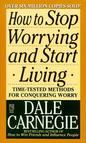
I read a book by Dale Carnegie when I was growing up, and I enjoyed it, so I decided to see what his writing was like a second time around. As someone who frequently takes things too seriously and is apt to worrying, I figured I might also pick up something useful from How to Stop Worrying and Start Living. The story is based on the author's experience in leaving his job to be happier and teaching classes on speaking and worrying less. I enjoyed learning more about his background as a "Missourah" farmer ("that old 'Missourah' farmhouse"). The book is a long collection of many anecdotes, so while it's not scientific, it's at least entertaining and interesting. Many of the pieces of advice are somewhat cliched (or perhaps this book created many of these since it was published so long ago), but it was a nice reminder of what's important in life and how to not sweat the small stuff. Below are my full notes. Part 1: Fundamental parts of worryCh. 1: Live in day tight compartments- Live in day tight compartments (shut out future and past)
- Only work on what's clearly at hand now
Ch. 2: Magic formula- Think of the worst possible that can happen
- Mentally accept the worst possible
- Improve on the worst
Ch. 3: What worry may do to you- Those who can't fight worry die young
- Lots of medical problems
- Recreation
- Religion
- Laughter
- Music
- Smiling
Part 2: Basic techniques in analyzing worryCh. 4: How to analyze worry problems- Get facts
- Analyze facts
- Decide
- Act
- What are you worrying about
- What can you do about it
- What are you going to do about it
- When can you start
Ch. 5: How to eliminate 50% of my business worries- Have employees write down memo of answers to 4 questions
- What is the problem
- What is the cause
- What are all the possible solutions
- What is your recommended solution
Part 3: How to break worry habitCh. 6: How to crowd worry out of your mind- Doing work replaces worrying
- Busy yourself
Ch. 7: Don't let the little get you down- Forget about little trivialities
- Don't make small nags
- Little beetles of worry
- Can be crushed with your thumb
- Life too short to be little
Ch. 8: A law to outlaw your worries- Law of averages
- Things we fear unlikely to happen
- Let's examine the record
Ch. 9: Cooperate with the inevitable- Be willing to have it so
- Accept difficulties quickly
- Carry on and smile
- Try to bear lightly what needs must be
- Accept things I can't change
- Change what I can
- Wisdom to know difference
Ch. 10: Put a stop loss order on your worries- If someone late by x minutes, move on
- Give impatience or worries small leeway then move on
- Stop loss on small relationship problems; stop complaining for things after a long time
- Just say enough now in fights
- Whenever tempted to throw good money after bad
- How important is this
- Have I already paid more than it Is worth
Ch. 11: Don't saw saw dust- Can't change past events
- Just analyze past and forget it
- Don't cry over spoiled milk
- Forget mistakes you make quickly
- Don't cross your bridges until you come to them
- Can't saw saw dust because already sawed, just like past
- Dont worry about past lost games
- Cant wash grain With water that's down the creek
- Prisoners write off misfortunes and accept life and enjoy it
Part 4: 7 ways to cultivate mental attitude of peace and attitudeCh. 12: 8 words that can change your life- What you think about makes you what you are
- Man is what he thinks of all day
- Biggest task: choosing your task
- Marcus Aurelius: Our life is what our thoughts make it
- Assume positive attitude
- Be concerned but not worried
- Calmly take steps to address
- Hypnosis of positive or negative attitude changes muscle tests
- Tremendous power of thought
- Our thoughts about our misfortunes more important than the misfortunes
- Regulate our actions which then change our feelings
- Act and speak as if feeling happy
- Smile, sing, hum no matter what
- Act as if everything normal, force yourself
- Just for today I will be happy
- Just for today I will adjust myself to what is instead of what want
- I will take care of my body
- Try to strengthen my mind with reading and something that needs thinking and concentration
- Exercise my soul: do 2 things I don't want to do, give back
- Be agreeable, dress nice, don't improve or criticize others
- Live through this day only
- Have a program for every hour to not hurry
- Have a quiet half hour for myself and relax
- Be unafraid and believe in love
Ch. 13: High cost of getting even- Hurt myself more than other person
- Resentment leads to hypertension
- Refuse to get angry at anything
- absorb yourself in cause bigger than self
- I have no time for quarrels, regrets, or hate
- Keep me from judging man before walking in his shoes for 2 weeks
- Love enemies
- Don't think about ppl we don't like
Ch. 14: Don't worry about ingratitude- Never expect gratitude
- Give for inner joy of giving
- Teach gratitude to children
Ch. 15: Will you take $1M for what you have- 90% of things are right, only 10% not
- Concentrate on the 90%
- Would not sell what we have for $1 million
- Be happy of what you have instead of think of what lack
- Count blessings each morning
- Count your blessings not your troubles
Ch. 16: Find yourself and be yourself- Don't combine a bunch of stuff from others
- Write your own book, voice
- Be the best of whatever you are
- Don't imitate others
Ch. 17: If you have a lemon, make lemonade- Best things are the most difficult
- Infirmities can end up helping
- Don't capitalize on gains, profit from losses
Ch. 18: How to cure depression in 14 days- Think every day on how can please someone
- Do a good deed everyday
- By giving happiness we receive
- Think of workers as human beings, make personal comments and compliments
- Take interest in others
- Lose yourself in service to others
Part 5: Perfect way to conquer worryCh. 19: How my parents conquered worry- Farmer parents, difficult life
- Nothing but debts in the end
- Parents religious
- Interested in religion like body and electricity, useful even If not understood
- Turn over worries to divine to take care of
- Prayer requires putting problem in words which is useful
Part 6: How to keep from worrying about criticismCh. 20: No one beats a dead dog- Ppl get satisfaction from kicking something good
- Ppl just jealous
Ch. 21: Do this and criticism can't hurt you- Ppl way more concerned about themselves than others
- Ignore only unjust criticism
- Just do best you can
Ch. 22: Few things I've done- Review week
- Franklin reviewed daily
- Battled one fault per week for 2 years
- Companies poll employees for feedback
- Ask for unbiased helpful criticism
Part 7: 6 ways to prevent fatigueCh. 23: How to add one hour per day waking- Take frequent rests
- Short map in afternoon
- Rest before you get tired
Ch. 24: What makes you tired and what you can do about it- Mental attitude makes fatigue
- Relax while you're doing your work
- Body relaxed like a limp sock or cat
Ch. 25: Avoid fatigue and stay young- FInd someone to discuss problems with
- Keep a notebook of inspirational quotes and photos
- Don't dwell on shortcomings of others
- Get interested in ppl
- Make schedule for next day at night
- Relax
- Lie flat on floor, tense muscles then let them relax let go of neck
- Breathe deep down
Ch. 26: Four working habits to prevent fatigue- Clear desk of all except current problem
- Order is heaven's first law
- Do things in order of importance
- If face a problem, decide then and there
- Organize, deputize, supervise
Ch. 27: How to banish the boredom that produces fatigue- Fatigue from boredom, not work
- Do things you enjoy
- Do your work as if you enjoy it
- Acting will make your interest real
- Daily pep talks to yourself
Ch. 28: How to keep from worrying about insomnia- Let go
- Pray
- Talk to your body and tell it to relax
- Put pillow under legs and arms
- If we get tired enough, will sleep
- If can't sleep get up and work
Part 8: How I conquered worry- Don't stew over events that haven't happened or out of control
- Patience and time resolve troubles
- Live with enthusiasm
- Read an interesting book
- Play games, physically active
- Relax while you work
- See troubles from long term perspective
It's been a month since my March travels, and I've been super busy since I got home. I wanted to take a few minutes and wrap up my notes and thoughts about New Orleans start-up culture and the NOLABound experience. Below are the rest of my notes for Days 3-4 of the trip as well as my larger takeaways at the bottom. Sorry for the length of the post! "I wish I had the time to write a shorter letter." Launchpad accelerator visit- Met Chris Schultz
- Launchpad coworking space and accelerator 3 yrs old
- Chris
- After Katrina wanted to create tech hub and one physical space
- Developer bought building and made it into hub
- Always welcome to drop in, no day rate
- Demo Day during Jazz Fest
- Now have several more such hubs in New Orleans
- Grassroots effort
- No government support
- Community came together
- Overnight success takes 5-10 years
- Moving to a place with a lot of interesting jobs
- Density of startups and cool ecosystem
- Low cost of living
- Accessible airport
- Ppl get started here who are based elsewhere
- Easy to get in and out
- Launchpad is coworking space
- Launchpad Ignition is accelerator program
- The more bankruptcies the better, means more ppl are trying
- Speed dating/hiring events
- 13 startups created 502 jobs
- Community running Rails class
- GE will put in $10M into higher ed for tech
- Several ppl from SF moved here for quality of life
- Lots to do, nice ppl, can own great home cheap
- Walkable city, all major events free
- Cutting edge of wave of development and excitement
- Issue is not starting businesses but about scaling, exiting
Big Idea event- B-plan competition
- Entrepreneurship is about networks
- Companies that won had the biggest networks
NOLABound camera crew notes (nice guys!)- All cams on 5dmkii
- L zoom lens 24-70 f2.8
- Boom mics
Talk by Alan Domesqieu (architect)- Architect
- Design studio of 50
- Grew up around here and through Katrina
- Tricentennial in 2018
- Katrina was a man made disaster
- Only mid-level storm
- All city levy systems failed
- Engineering failure
- No respect for FEMA
- Engineering core not trusted
- Cities around world evaluating their levy systems now
- Sacramento has highest risk for levy failures now
- Lots of brick and mortars
- 40% of American watershed comes across French quarter
- How will NOLA port compete with Panama Canal widening?
- Probably will be behind Houston, Mobile
History- NOLA established in 1718 by white Europeans
- Have had Native Americans there for centuries before though
Tricentennial comes with 3 obligations- Marking history
- Celebration of recovery
- Charting a course
Katrina work- Build infrastructure for continued business growth
- Celebrate authenticity
- Way of life, not lifestyle
- How are we rearming our community as we strengthen the levies?
- Flooding spread 22mi x 15mi
- Population decline
- White flight
- Segregation
- African American middle class
- Population went from 627k down to 455k before Katrina then to 20k with Katrina
- Forecasts population recovering to 400k by 2020
- Population determines federal revenue sharing
- Ppl who left on buses were given one way ticket
- Buses were not coordinated by government and families got split who didn't know where buses went; took years to reunite
- Had no formal evacuation plan
- Biggest problem is figuring out how to get ppl back in to a damaged city
- Tourism not sustainable, lowers in economic downturns
- Brick and mortar infrastructure will be real foundation
- $2.2B medical complex being built by gov't
- Will employ 25k ppl
- Largest medical complex being built outside Kuwait
Crawfish Boil- Fun outdoors
- Played some cornhole
- Benjy Davis Song: I Love New Orleans
- "Put your hand in a crack and you might find a treasure": Counselor lost her engagement ring on Frenchman Street pub crawl and then found it the next day because another NOLABounder saw it in a crack on the street! True miracle.
- Build community through regular city events and festivals every 2 weeks that everyone goes to
Various impressions of city from touring it on my own the last day- Rivers of Los Angeles = freeways (but also have sweet ocean)
- Canal St and French Quarter shops
- Ate at Stanley's: "po boy" with sweet potato fries
- Took ferry to Algiers and ate a cookie at Tout Sweet (awesome name)
- Threw down $20 and doubled my money on blackjack at Harrah's (I only play 1 hand)
- Watched Hurricane in the Bayou IMAX film
- Spoke French with Haitian taxi driver
- "Biggest small town"
- People stay for the culture
- GE Capital coming to NOLA with 500 jobs
- More diversity
New Orleans News and Stats- Based on jobs and output, The Brookings Institution has named Greater New Orleans one of the "20 Strongest Performing Metros" in the nation for Q4 2011. More info here.
- Sports Illustrated magazine is running in-depth feature on the story of the New Orleans Hornets, who it calls one of the most "promising and inspiring" teams in the NBA. In particular, the article highlights the effort to keep the Hornets in New Orleans, including meeting a challenging attendance threshold, and then selling more season tickets, per capita, than any market in the USA. You can read the article online here.
- Business Facilities magazine has named Greater New Orleans, Inc. as one of the top three in the USA in its new award for overall "Economic Development Excellence." GNO, Inc. finished tied #2 with Greater Oklahoma City; the top place went to Greater Austin. "2011 was a remarkable year for Greater New Orleans," wrote Editor-in-Chief Jack Rogers, going on to call the region "a shining model of diverse, growth-oriented success." The award article is online here.
Big takeaways- Tax incentives and gov't cooperation are huge
- Community through frequent cultural events
- Close bonds and love of city (Fleur de lis everywhere); 2 degrees of separation
- Exciting tech community
- Problems with crime and education are being dealt with
- Poor perception management and marketing out of state are being addressed
- Amazingly talented people working in NOLA who love the city
- Amazing group of NOLABounders who rallied and bonded
- Warm weather all day and evening though a bit humid
- Awesome food though less on healthy options
- Amazing trip!
How Disruption Brought Order- Culture
- Company culture is everything
- History of TBWA, Chiat/Day, BDDP
- Creative is not a Department
- Values
- Transparency (Accounting, ethics)
- Audacity
- Open-mindedness
- Skills
- Organization: Matrix decision making between global and local
- Integration
- Action plans
- New business activity: Nothing left to chance
- Internal communication: Weekly employee memos
- Principles
- First convictions
- Accumulate experiences
- Counterprinciples
TBWA Office Visit- Philosophy: disruption
- Challenging status quo
- Creating brand behavior for the modern world
- Start with brand belief (ideal)
- Human insight
- Brand behavior: way brand behaves to honor belief
- Gatorade: Win from within
- Change from hydration to helping before, during, and after
- Insight: athlete looks for edge at all 3 phases
- Pacific Standard Time art exhibit
- Pop culture meets art culture
- Insight: culturally curious ppl untapped
- Grammy's: Using technology to uncover raw emotion of music
- Insight: more than what hear, what feel
- Artists as unified with their music
- Integration between TV spots, interactive website, print, outdoor, wild postings, phone app
- Create artist out of the music
- Twitter concert on street (sing your tweets)
- Immerse themselves in client's problems
- Assessing new clients
- Clients need to understand that marketing is not necessary evil but hugely important in making diff in brand
- Do they have the power to see the ppl who can say yes
- Needs access to everything
- Need to be able to manage them profitably
- Ask clients who they admire, who want to be like
- Office
- Mix of private high-density seating and open spaces
- Unlocking playfulness
- 700 ppl office is village with different neighborhoods
- A building helps u manage your ppl
- Architectural mgmt
- Create an environment where creativity more likely
- Cool office with eclectic architecture
- Colors
- All open space
- Tons of dogs
- Sitting areas
- Everyone has MacBook and iMac
Change by Design- The new social contract: we’re all in this together
- Every product is already a service
- HMW: how might we improve the airport security checkpoint experience?
- Not just buyers and sellers; participants in 2 way process (Wikipedia, Android)
Steve Jobs- Not a computer scientist
- Reinvented industries
- Refused focus groups
Grow: Keep it going: evolving the ideal for comparative advantage- Motorola Solution made posters of its ideal, video
- HP Ideal: human progress
Class summary- Finding and activating your ideal
- Pyramid of influence model (Nike)
- Athletes at top 5%
- Weekend warriors who play regularly 15%
- Mass market 80%
- If sell shoes to the athletes, weekend warriors will want and then mass market will want
- Nike started by first selling to athletes, then others got interested when those athletes won
- Everything is media
- Apple Stores (stores as media)
- Delivering an ideal-based brand experience
- Measurement
Stengel Top 10 habits- Reveal your inspirational brand ideal and operationalize it
- Be clear what you stand for and be visible inside and out
- Design your organization for what you need to win: core work, capabilities, and career path
- Begin with a rough audit of work ... how close is your organization to the right design
- Get your team right.
- Champion innovation, especially disruptive innovation.
- Set your standards very high.
- The most powerful comment from a leader: “You are capable of so much more than this.”
- Train all the time.
- Do a few symbolic things (i.e., Brand Health Checks).
- Think like a winner, act like a winner.
- Live your desired legacy.
P&G- Purpose inspired growth strategy
- Different relative importance of products for people’s lives
- Developing leaders
- Most promotion from within
- 30% come from acquisitions
- Do not use headhunters
- Very difficult to be good leader
- How many ppl consider you a role model?
- What impact are you making?
- You have responsibility if you are someone’s role model
- 3 categories of ppl: people who let things happen, who make things happen, who wonder what’s happening
- As a human, you’re in all 3
- You as a brand
- Are there stories about you?
- There are always stories; question is what are the stories?
- Do you care about the stories?
- What does a brand have?
- A target who (they want to go after): first decide who you want to sell to
- A positioning (they want to own)
- Want consistency in people’s response of 1-word equity behind brand
- Volvo = safety #1 around the world
- An image (they get as a result of the above)
- Technology/social media affects it
- Ask your friends: what is my 1-word equity?
- What is a brand?
- Product
- Service
- Experience
- Person
- Institution
- Place
- Promise
- Emotion
- Commitment
- Responsibility
- Team
- You as a brand
- Coke: $70B, Nokia: $30B
- How much are you worth?
- Who is your target?
- What is your positioning?
- What is your image?
- 2 concepts
- Strategies: when you’re making a clear choice w/ consequences
- Lose weight (goal) => join gym (strategy) => plan
- Choice that is really a choice
- it has clear consequences
- it comes before plans
- Strengths: before, focused on improving weaknesses (huge self-improvement industry in US)
- Now, focus on your strengths
- Must match strengths to job
- What are you really good at
- What you leverage most of the time
- What you keep working on
- Moroccan women spend 6 hours per day today washing stuff
- Tip #1: (try to) be clear about what matters to you the most
- Tip #2: change is the only constant. Embrace change. Learn how to thrive under change.
- Tip #3: treat everybody with respect, be straight and tell them the truth. Have a point of view.
- Tip #4: be yourself and leverage your strengths. We all make a lousy somebody else. Don’t imitate role models.
- Tip #5: have dreams, aspirations and ambitions. But focus your energy on the job you are doing, not the next one.
- Tip #6: you are only as good as other ppl think you are
- Annual 360 degree reviews of strengths & opportunities (give list of ppl to boss and boss subtracts and adds)
- Tip #7: always provide constructive criticism
- Tip #8: your personal leadership matters
- Tip #9: have fun
- Tip #10: always help others and feel comfortable to ask for help
- The best time to plant a tree is 20 years ago. The second best time is today. –Chinese Proverb
Sorry, ya'll, been super busy, but wanted to chug through some backlog of posts to get to fresher content. Below are my penultimate notes on brand management. Age of consumer capitalism- Focus on customer first, not shareholder value
- Managerial capitalism
- Customer-driven capitalism
- Maximize customer value subject to minimum shareholder value
Grow: Evaluate progress and people against the ideal- Brand contribution to market value has risen heavily
- Quarterly brand index
- KPIs in terms of ideal
- Toyota: dedication to people
- Link ideal to employees' daily work plans
- Design performance reviews by focusing on how and ideal
- Reward time spent with end customers
MillwardBrown Brand Database Speaker- Apple #1 brand in world by brand value of BrandZ Top 100
- China Mobile only Chinese one in top 10
- Measuring the effectiveness of super bowl advertising
- Sales effects
- Equity effects
- Turned out that super bowl ads had good ROI
- 1. Iconic brand
- 2. Top league of advertisers
- 3. In mind of consumers, this has big impact
- Using measurement to create business case
- Great brand examples: Apple, Starbucks, Method, LVMH, Chandon
It was long overdue, but I finally finished reading The Innovator's Dilemma by Clayton Christensen, an HBS professor. So many people kept citing this work around me, and I now understand why. The book is a bit slow and dry in its writing style, but the key points are incredibly deep, thought-provoking, and not as often discussed in start-up pop culture. My biggest takeaway is that when companies are doing the "right" things, like being good managers, following business school teachings, executing, listening to customers, etc., these practices that help them scale successfully are exactly the WRONG things to be doing when confronted with disruptive innovation. That's the core of the dilemma. As a start-up gets traction and grows into a big company, it makes it much less likely that it will be able to keep doing disruptive innovation. This is a really interesting concept, and one that's bittersweet. My notes are below. You can also download a great book guide that was included in the book at the bottom of this post (sorry for the quality, I took the photos on my phone). I really enjoyed the book, even though it took me a while to get through it (this was a physical copy I was reading for 10-20 pages at a time). Part 1: Why great companies can failCh. 1: How can great firms fail- Disruptive innovations technically straightforward
- Studied disk drive industry
- Known tech in unique architecture
- Advanced tech development for sustaining innovation
- Customers of incumbents demand sustaining innovation
- Firms that led disruptive innov always entrants who developed for new mkt and not for current customers
Ch. 2: Value networks and the impetus to innovate- Different value networks (industries, target users) have different needs and cost structures, assigning value to different components of products
- Incumbents listen to lead customers and don't pursue disruptive innovation because isn't appropriate for value network
- Entrants seek fit via trial and error with some value network that wants their disruptive product
- Then later entrants grow and expand into territory of incumbent and by then it's too late for incumbent to respond
- Customers mislead in advice around disruptive innovation
- Technology s-curve framework: tech supplants old tech when second derivative negative (past inflection point)
- S-curve only for sustaining innovation (disruptive along new curve)
- Initially disruptive tech is worse in most product attributes than majority value network care about; only better in an attribute that small value network cares about which is uncertain and must be discovered
- Over time, if trajectories of what 2 techs deliver to different value networks over time cross, then disruptive tech can overshadow and meet needs of both value networks, threatening incumbent firms
- Flash disk drives vs DRAM
Ch. 3: Disruptive innovation in mechanical earthmoving industry- When disruptive innovation comes out, majority of market doesn't want it
- Search for market that could use it and appreciates its value
- Then as product improves along axes the majority care about, can expand into there
- Hydraulic excavator vs. cable system
Ch. 4: What goes up can't go down- Moving upmarket to higher price points easier for customers than moving downmarket into lower price, smaller market opportunities (as is required for disruptive innovation)
- Managers also prefer higher margin, proven market projects
Part 2: Managing disruptive innovation- Good (not bad) management to blame for missing disruptive innovations
Ch. 5: Give responsibility for disruptive technologies to organizations whose customers need them- Customers allocate an org's resources, not mgmt (resource dependence theory)
- Result is need to create an independent org and embed it among emerging customers that do need disruptive tech
- Same org can't keep supporting mainstream customer and pursuing disruptive innov
Ch. 6: Match the size of the organization to the size of the market- Leadership in sustaining technologies not essential (can be follower company)
- But is essential in disruptive
- Big companies searching for big markets to sustain growth rates; disruptive tech for small markets not interesting
- Acquire a small company and launch products through it
Ch. 7: Discovering new and emerging markets- Market apps for disruptive tech unknowable
- Discovery and learning, not execution
- Market research and listening to customers impossible
- Expert forecasts always wrong
- Failed ideas versus failed businesses: most successful ventures abandon original biz strategies after learning
- Managers often can't deviate from plan
- Plans to learn vs plans to execute
- Discovery-driven planning
- Smaller batches
- Agnostic marketing: no one (us or customer) knows size of market until you try
- Get out of the building and test (same stuff as custdev and lean startup teachings!)
Ch. 8: How to appraise your organization's capabilities and disabilities- Only companies that succeeded in disruptive tech are those who create independent orgs whose size matches size of opportunity
- Organizational capabilities determine where it can succeed
- 3 factors: resources, processes, values
- An org's processes and values also define what it can't do
- Values are decision rules
- For companies to maintain growth rate as they grow, have to ignore small markets (Wall Street cares about earnings growth percentages)
- Bittersweet reward of success: lose the capability to enter small markets
- Problem with mergers and acquisitions
- If acquiring for resources, integrate acquiree
- If acquiring processes or values, let acquiree stand alone
- Acquiring to create capabilities is good
- Resources can change easily but processes and values much more rigid and limit developing new capabilities internally
- Create spin-out venture with new processes when big org values and growth rules prevent it from doing disruptive work
Ch. 9: Performance provided, market demand, and product life cycle- Performance oversupply satiates customer demand and customers no longer willing to pay price premium so start considering other aspects; basis of competition changes, allowing new entrants
- Product becomes commodity with only price competition once exceeds all market demands/needs and no more features/differentiation is needed
- Performance oversupply drives transition from one phase to next of product life cycle
- Based on product and vendor availability over time, customers choose products first based on functionality, then reliability, then convenience, then price
- Performance oversupply causes phase transitions between these
- Chasm model is user-centric but shows same transitions
- Aspects of disruptive tech that make it unsuitable for mainstream mkt make it perfect for emerging mkt
- Disruptive tech usually simpler, cheaper, more reliable, and convenient
- Sustaining tech assumes existing market needs valid and has a technological problem of improving product to meet them
- Disruptive tech seeks to find market that fits and has a marketing problem of finding the market that will accept the tech
- Strategies: move up market towards higher end customers along life cycle, stay with customers as they move along life cycle, market to change customer demand for new product functionality
Ch. 10: Managing disruptive tech change case study- Electric vehicle example
- Is tech disruptive?
- Look at market behavior, not interviews. Plot market performance demanded over time. If exceeds new tech capacity, then might be disruptive
- Look at performance improvement of new tech over time. If growing faster than market performance demanded, then can be disruptive on day (will intersect market need curve)
- Where is the market for the new tech?
- Ignore mainstream
- Find a market that values the disadvantages of the disruptive tech compared to mainstream
- No one can learn from market research where the right market is for an emerging market
- Only way to learn is through expeditions of trial and error, prototyping, selling real products to real ppl paying real money
- Business plan must be one for learning, not executing strategy
- Product: simple, reliable, convenient. Designed for quick and cheap iteration. Low price point.
- Product plan cannot rely on achieving breakthrough tech innovations. Disruptive tech usually combines existing stuff in new way.
- Distro strategy: usually new value network and channel needed because existing has clear formula that doesn't fit
- Create independent org or spin-off so not competing against current needs and resources
- Bigger org's best for sustainable innovation
Ch. 11: The dilemmas of innovation summary- 1: Pace of market need doesn't always match tech progress
- Cannot just be guided by current customers
- Use tech trajectory maps
- 2: mgrs are honed for profitability, and it will be very difficult to keep allocating resources to disruptive tech
- 3: disruptive tech is a mktg challenge, not a tech challenge
- Find a mkt that values characteristics of disruptive tech in current form
- 4: org's capabilities much more specialized than we believe because tuned to one value network
- Not fit for disruptive tech
- 5: disruptive tech very risky so need to focus on quick learning and tolerating failure
- 6: must use diff strategy in leading disruptive than sustaining innov
- 7: biggest companies make their own barrier to entering and investing in disruptive tech at the most important times that entrepreneurs can take advantage of
 | innovators_dilemma_book_guide.pdf | | File Size: | 2561 kb | | File Type: | pdf | Download File
|