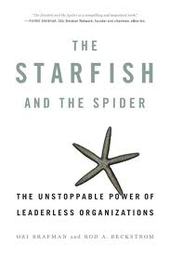
 I just recently finished reading The Starfish and The Spider: The Unstoppable Power of Leaderless Organizations by Ori Brafman and Rod A. Beckstrom. It was a neat overview of the different elements of decentralized organizations and many of the ways in which they operate and can be superior to centralized organizations. The book starts with the story of the modern science around memory. Scientists for ages thought that specific neurons and parts of the brain were assigned to specific memories. However, after a lot of testing, they found something surprising about accessing and storing memories in the brain: they are in fact not stored in specific neurons; they are stored everywhere. There turned out to be no hierarchy or chain of command in the brain; memory turned out to be fully distributed. This distributed structure makes the brain more resilient and is the reason why unpleasant memories are difficult to eliminate. The first major example of a decentralized organization outside of the brain centered around Sean Fanning and Napster. The havoc that Napster wreaked on the music industry as well as the freedom it brought to students and consumers of music were clear examples of the power of decentralized/peer-to-peer organizations. Another example the book looked at was Al Queda, where the leader is hidden, and different terrorist cells operate autonomously. Wikipedia is another important example, where collaborators around the world contribute and police it, all voluntarily. When the founder of Wikipedia was asked by the authors who runs its servers, he responded, "I don't know. The users just take care of it." That seemed pretty neat (and scary) to me. The key takeaway here was that all of these organizations were using the absence of clear and commanding hierarchy structure as an asset. MGM's Mistake and Apache's Mystery The book analyzed the way MGM fought Grokster (another P2P file sharing program) in the Supreme Court and compared this to the story of the Apache tribe. When MGM was awarded a winning verdict, they were able to take down a fairly centralized organization for file sharing (Grokster wasn't fully P2P like eMule). The lesson there was that a centralized organization can fall when you kill its center. On the flip side, the story of the Apache ends differently. When Cortez and the Spanish army arrived, they conquered and annihilated the other tribes who were centralized societies. The Spanish couldn't defeat the Apache just like the record labels in the end couldn't squash file sharing when it became fully distributed. The Apache distributed political power and had little centralization; therefore, the Spanish could never really fully conquer them. A central organization operates on coercion. An open organization operates on leading by example. People follow someone because they want to, not because they have to. When attacked, a decentralized organization becomes more decentralized. Napster was centralized and so fell quickly when attacked. eMule was fully open source and distributed with no declared leader or owner. No matter how hard you attack it, you can never fully destroy something so decentralized as that. The Spider, The Starfish, and The President of the Internet When the head of a major telco went to Europe for a business meeting pitching the Internet as it was just being rolled out, he was questioned as to who was the president of this new organization (the Internet). It was impossible for his business colleagues to understand that there was no president of the Internet; it's a network of networks that just works together through mutual agreement rather than hierarchical ruling. This was very hard for people to get initially (he had to in the end say that he was in the fact the "President" of the Internet in order to appease his audience). This was a classic example of people who mistook a starfish for a spider. A spider has 8 legs with a central body. If you chop off its head, it dies. A starfish is totally different. It has separate control of its legs, and its organs are replicated throughout its body. If you chop off any part, it will grow back. In fact, it can replicate itself fully from just one arm. This seems so incredibly cool to me. For the starfish to move, its arms convince each other to do it; there is no central brain. I absolutely love this metaphor for how certain organizations can operate. The book explained how Alcoholics Anonymous (AA) is an organization that is a starfish. No one owns it. There is no central intelligence; intelligence spreads throughout the system itself. In this way, a decentralized organization sneaks up on you, mutates, and grows quickly. The Accordion Principle: Industries swing back and forth between being centralized and decentralized. A Sea of Starfish The book went through many examples of products or organizations that took advantage of starfish principles to thrive: Skype, Craigslist, Apache web server software, Wikipedia, Burning Man, and the Quakers. Several principles came out of these examples. Put people into an open system, and they will automatically want to contribute. A catalyst is responsible for sparking ideas and then getting out of the way. Here are his or her main tools: genuine interest in others, passion, meeting people where they are, trust, inspiration, tolerance for ambiguity, being ok with saying he or she doesn't know, a hands off approach, and an ability to recede. A leaderless organization operates through norms, not rules. Taking on Decentralization When attacked, a centralized organization get more centralized. Think of army bunkers getting more fortified. The only ways to attack a decentralized organization is through ideology (convincing them of a new way) or to centralize them by giving them a scarce resource (like money or cows) in order to create internal competition and hierarchy. It is somewhat sad that a right to property and money almost always leads to centralizing an organization. Fight starfish with starfish. Hybrid Organizations (The "Combo Special") The decision around centralization doesn't have to binary. Many organizations have successfully used starfish principles in certain parts of their operations and not others. An example of this is eBay, where the decentralized user ratings are critical to eBay's competitive advantage. The company itself is a spider, but it operates as a centralized company that decentralized the customer experience. They kept centralized what people wanted to know would be secure and regulated: money (i.e., payment through PayPal). Other examples are Amazon reviews and Oprah book clubs, which decentralized by giving customers an important role. Companies who have open sourced part of their software (like Sun) are further examples. In HR, getting employee ideas and open brainstorming after alignment interviews between random pairs of people across the entire organization is a way to source decentralized opinions for centralized decision making. The Sweet Spot The "Sweet Spot" refers to the level of decentralization that's just right for a given organization, and this changes over time and across companies.This chapter looked at the example of Toyota versus GM. GM was way more centralized and used a traditional assembly line process; Toyota used lean principles and let line employees fully dictate how the operations would run. Toyota bet GM that this was not due to culture, race, work ethic, or anything outside of the pure decentralization of operations. Toyota offered to demonstrate this to GM, and this was the start of the partnership that became Nummi, where team leadership had control as opposed to some central authority; Nummi quickly became the most efficient and profitable plant in GM. Another example of a product that finds some happy medium between centralization and decentralization is iTunes, which allows people to download music quickly and get individual songs (rather than buy full CDs) but does so in a way that's legal and ok with the music industry. The New World This final chapter went through the 10 rules of how modern organizations operate, taking into account the starfish principles outlined in earlier chapters:
This was a fun read and now makes me think about centralized and decentralized organizations pretty differently.
1 Comment
 I rarely whine or complain about stuff I don't like, but it's about time I aired some of my frustration.
I think paper, hand signatures in this day and age are stupid and insecure. They can easily be forged/reproduced, and often times people spend little effort in making sure they sign things carefully and the same way every time. In addition, they require using paper (a limited resource) and extra effort and time. I need to print out 2 copies of a contract, sign them both with a pen, put them in an envelope, mail it to the other person, and then wait to get a fully executed copy back in the mail (remembering to follow up if it doesn't come). Faxing gets rid of the envelope and mailing step, but it's often still slow, cumbersome, and low quality (and you're stuck with another paper copy that you then need to scan back into your computer and store in a folder). This just seems so operationally inefficient to me. Using secure e-signatures, for example, seems like so much better of a solution. I know there are various laws that require physical signatures (such as in real estate transactions and consumer home purchases), but I think that needs to change and be modernized. There are so many better, easier to use technologies in existence that are more secure and more efficient. As I understand, there are 3 ways to authenticate a person: something you know (e.g., password), something you are (e.g., biometrics)/something you do (e.g., signature, voice perhaps), and something you have (e.g., RSA token). At this point, I understand some of these technologies may still be a bit expensive to roll out on a large scale, but I really think this is where things are going in the future. But that's not all. For my work on AMA, I had to negotiate and sign a lot of complex legal contracts. I saw so much inefficiency with respect to the work required to revise and collaborate on contracts with multiple counterparties and attorneys. And making sure you don't drop the ball on any important revision or issue is all up to you and your organizational/checklist-tracking abilities. Managing the contract after execution is similarly manual, requiring calendaring, databasing, scanning, and manually indexing/categorizing the critical terms, references, and dates. I don't know how many people suffer through these pains, and I'm hoping to learn through any feedback or comments people leave. What do you all think? I definitely think there's a better way to do things, and that's what I'm hoping to achieve through Redlyne. 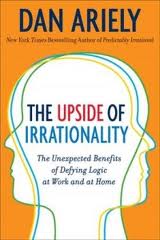 I recently enjoyed listening to the audio version of Dan Ariely's The Upside of Irrationality. He's also the author of Predictably Irrational, which I hope to read soon.
The author, a behavioral economist and psychologist, begins by introducing an irrational behavior that affects all of us: procrastination. He says that procrastination is universal. When he sought a special treatment for a rare condition he had, he needed to inject himself with very uncomfortable medications on a weekly basis. In order to get himself to not procrastinate, he motivated himself with watching movies on his injection days, thereby associating good with bad. As humans, we prefer short-term, not long-term goals. We routinely fail to take short-term pains for long-term goals. He explains that there is a lot of human-incompatible technology out there that doesn't take into account our fallibility (like the stock market). While his first book (Predictably Irrational) is about the downsides of irrationality, this book is about its upsides. The first part of the book is about defying logic at work. Throughout the text, the author explained in detail the scientific studies used to come up with the conclusions presented. It was neat to understand how the experiments were designed.
The book was informative and entertaining from the experiment-design standpoint, and as someone who likes learning about psychology, I enjoyed the book very much. |
Archives
February 2023
Categories
All
Subscribe |
 RSS Feed